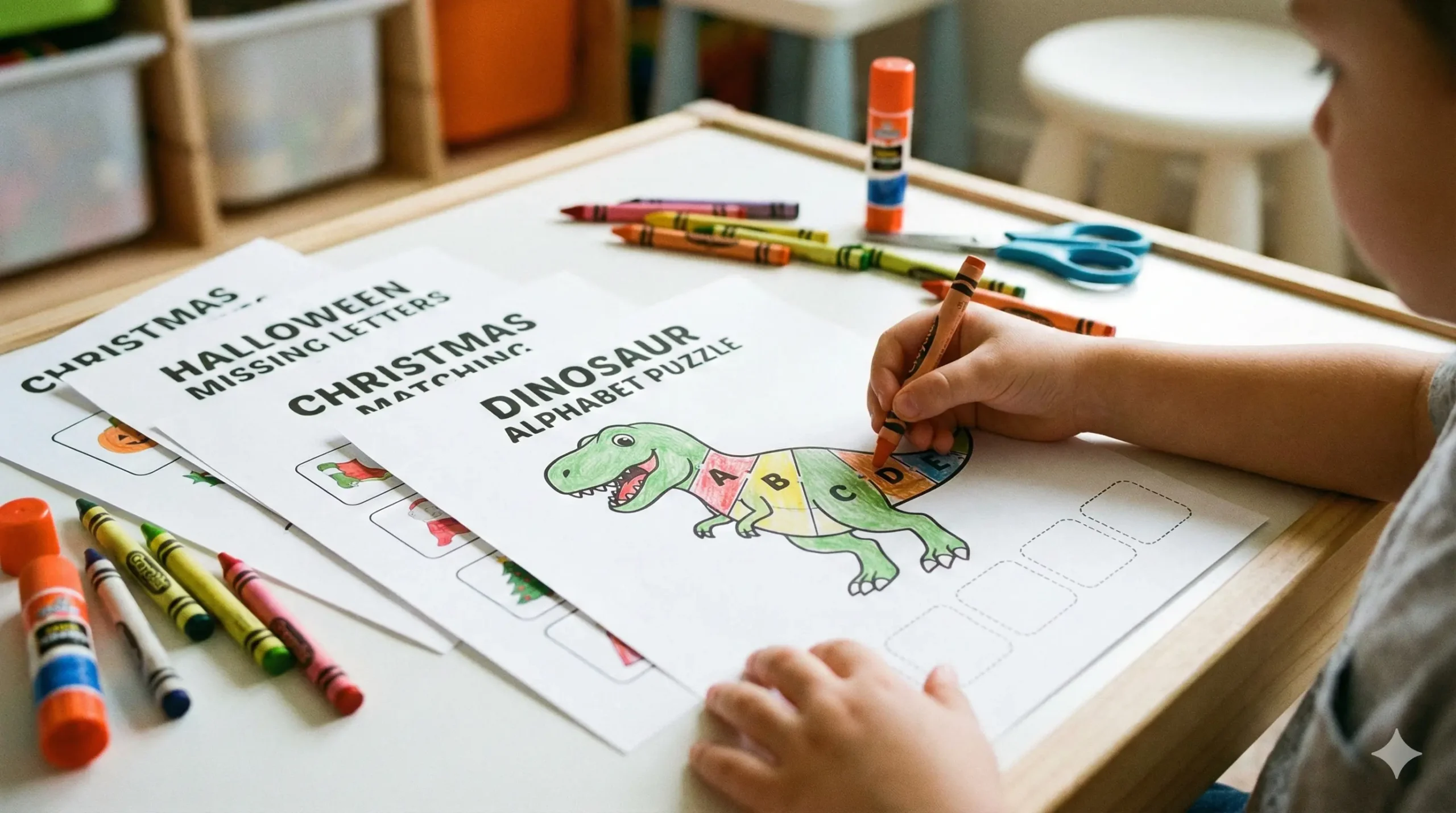
What is the very first “serious” academic lesson every child encounters? No matter where you are in the world, the answer is almost always the same: The Alphabet.
It is the fundamental stepping stone to literacy. Mastering those 26 letters opens the door to reading, which subsequently unlocks the entire universe of knowledge. However, as any parent or teacher knows, learning the ABCs isn’t just about rote memorization; it is about engagement, recognition, and fun.
If you have a toddler, preschooler, or kindergartner currently navigating the world of letters, you need resources that cater to different learning styles. Some kids are visual learners, while others need tactile activities. This is where high-quality alphabet printables save the day.
Below, we explore 20 awesome alphabet printable concepts—from seasonal themes to dinosaur puzzles—that will transform your child’s lessons from a chore into a game.
Why Use Printables for Learning the Alphabet?
Before diving into the activities, it is important to understand why printables are a staple in early childhood education. In an age of tablets and screens, paper-based activities provide unique benefits:
- Fine Motor Skills: Holding a crayon or pencil helps develop the hand muscles required for writing.
- Focus and Retention: Physical worksheets reduce the over-stimulation often associated with digital apps.
- Versatility: You can cut, paste, color, and laminate these resources, turning them into multi-sensory tools.
Here are 20 fantastic categories and ideas for alphabet printables to get your little one started.
1. The Prehistoric Puzzle: Dinosaur Letter Ordering
The alphabet certainly didn’t exist when the dinosaurs roamed the earth, but that shouldn’t stop us from using T-Rex and Stegosaurus to teach literacy!
The Concept: A “Dinosaur Parade” puzzle. How it Works: This printable features a long dinosaur (or a line of them) where the body is divided into segments. Each segment contains a letter. The child must cut out the pieces and arrange the dinosaur back together in alphabetical order (A to Z). Educational Benefit: This teaches sequencing. Knowing that ‘B’ follows ‘A’ and ‘Z’ comes last is a critical pre-reading skill.
2. Giant Capital Letter Coloring Pages
For absolute beginners, standard worksheets can be overwhelming. The Concept: One giant letter per page. How it Works: Focus strictly on uppercase (capital) letters first. They have straighter lines and edges, making them easier for young eyes to distinguish compared to the curves of lowercase letters. Activity Idea: Don’t just color! Have your child stick dried pasta, buttons, or cotton balls inside the lines of the letter to create a textured 3D effect.
3. The “Missing Letter” Halloween Challenge
If your child is starting school around September or October, utilize the excitement of Halloween to fuel their learning. The Concept: Spooky sequences with gaps. How it Works: Create a string of pumpkins or ghosts, where some hold letters and others are blank (e.g., A, B, [__], D). The Task: The child must figure out the missing letter and write it in the empty pumpkin. This tests their memory of the alphabet order without the pressure of a test.
4. Christmas Letter Matching
The holiday season provides a colorful backdrop for literacy. The Concept: Upper and Lowercase Gift Matching. How it Works: A printable sheet featuring Christmas trees (Uppercase) and ornaments or gifts (Lowercase). The Task: The child draws a line connecting the Capital ‘A’ tree to the lowercase ‘a’ gift. Bonus: Include a small picture of an object starting with that letter (e.g., ‘B’ for Bell) to reinforce phonetic sounds.
5. Dotted Line Tracing Workshops
Once a child recognizes the letters, the next step is reproduction (writing). The Concept: “Connect the Dots” typography. How it Works: These printables feature letters made of dashed lines. Pro Tip: Look for sheets that offer both uppercase and lowercase options side-by-side. Sustainability Hack: Print these on cardstock and slip them into a plastic page protector. Give your child a dry-erase marker. Now, they can practice, wipe it clean, and practice again endlessly without wasting paper!
6. Back-to-School Bus Coloring
The transition to school can be scary, but familiarizing kids with school icons helps. The Concept: The Alphabet School Bus. How it Works: A coloring page featuring a school bus where the windows or wheels contain letters. The Task: Create a “Color by Letter” key. For example, “Color all the A’s red and all the B’s yellow.” This forces the child to look closely at the shape of the letter to distinguish it before coloring.
7. Springtime Garden Trivia
Spring signifies growth, making it the perfect metaphor for growing knowledge. The Concept: Flower Petal Sounds. How it Works: A printable featuring a flower center with a letter (e.g., ‘S’). The Task: The child must color or draw petals that represent things starting with that letter (Sun, Snake, Seed). Why it helps: As mentioned in your intro, there is no harm in learning trivia! This combines science (plants/animals) with literacy.
8. Animal Alphabet Flashcards
The Concept: A classic staple that never fails. How it Works: Printable cards where the letter is shaped like an animal (e.g., an ‘S’ shaped like a Snake, a ‘C’ shaped like a Cat). Usage: These are great for visual learners who need an image hook to remember the shape of the letter.
9. The “Letter Hunt” Detective Sheet
The Concept: Finding the needle in the haystack. How it Works: A page filled with random letters of various sizes and fonts. The Task: “Circle all the letter T’s.” Educational Benefit: This improves visual discrimination, helping kids recognize a letter even when it’s written in different styles.
10. Food Alphabet Place Mats
The Concept: Learning at the dinner table. How it Works: Printables designed to be laminated and used as placemats. They feature food items (A for Apple, B for Banana). The Task: While waiting for dinner, kids can trace the letters with their fingers or a safe marker.
11. Through 20. Rapid Fire Ideas for Diverse Learners
- Robot Parts: Build a robot by gluing “Letter Parts” together.
- Raindrop Counting: Blue raindrops with letters falling from a cloud. Good for rainy days.
- Car Track Letters: Letters drawn as roads; kids drive toy cars over the shape of the letter.
- Q-Tip Painting: Letters composed of small circles perfect for dipping a Q-Tip in paint and dabbing.
- Alphabet Bingo: A fun printable game for a group of kids or siblings.
- Ice Cream Scoop Stacking: Match the ice cream scoop (lowercase) to the cone (uppercase).
- Space Aliens: Help the alien find his spaceship by following the path of alphabetical letters in a maze.
- Ocean Life: Fish bubbles containing letters; color only the vowels.
- LEGO Mat: A printable grid where kids place a LEGO brick on the matching letter.
- My Name Printable: A customized sheet focusing only on the letters in the child’s name (the most important letters to them!).
How to Organize Your Printing Station
To make the most of these “Awesome Alphabet Printables,” organization is key. If you are a parent or a teacher, you don’t want loose papers floating around the house.
- Create a Binder: Punch holes in your completed printables and keep them in a “My First Alphabet Book” binder. This allows the child to look back at their progress.
- The “Work in Progress” Tray: Keep a specific tray for sheets that are currently being worked on.
- Supply Caddy: Keep crayons, safety scissors, and glue sticks in a portable caddy specifically for “Printable Time.”
The Golden Rule: Fun Over Perfection
When using these printables, remember that the goal is exposure and enjoyment. If your child colors the “A” green instead of red, or scribbles outside the lines of the “D,” that is perfectly fine.
The primary objective of these alphabet printables—whether they are Halloween-themed, Christmas-themed, or dinosaur-themed—is to build a positive association with learning. You want your child to see a piece of paper with letters on it and think, “This is going to be fun,” rather than, “This is work.”
Conclusion
From the roar of a dinosaur puzzle to the spooky fun of Halloween missing-letters, there is a printable style for every child. By rotating through these different themes—Back to School, Spring, Christmas, and more—you keep the learning process fresh and exciting.