When we think of the ocean, our minds often drift to the terrifying sharks or the massive whales. But let’s be honest: fish are grossly underrated! Often diminished to just something we put on a dinner plate, we miss out on the incredible vibrancy, history, and mythology surrounding these swimming wonders.
From the shimmering scales of a Koi to the bioluminescent wonders of the deep sea, fish are nature’s most colorful canvas. This makes them the absolute perfect subject for children’s crafts. Whether you are a teacher planning an “Under the Sea” unit, or a parent looking for a rainy-day activity, this guide to 20 Fun and Fantastic Fish Crafts will spark creativity using everyday items like paper plates, pipe cleaners, and recycled materials.
But before we grab the glue sticks, let’s dive into why fish are so special.
More Than Just a Dish: The Fascinating History of Fish
Did you know that the study of fish in culture actually has a scientific name? It is called Ethnoichthyology. This field explores our knowledge of fish and their massive significance in human society. You would be surprised to learn that fish are widely respected in legends and myths around the world!
Teaching your kids these fun facts while they craft adds a layer of educational depth to the activity:
- Ancient Wisdom: In Sumerian mythology, the fish was a symbol of Enki, the god of water, knowledge, and creativity.
- Sacred Symbols: The Syrian chief goddess, Atargatis, considered fish so sacred that only her priests were allowed to eat them during special festivals.
- Symbols of Happiness: In Buddhism, a pair of golden fish is used to symbolize happiness and freedom, largely because fish have total freedom to move through the water without drowning.
- The Avatar: In Hinduism, the god Vishnu is represented as Matsya, an avatar that takes the form of a great fish.
- The Stars: Look up! The zodiac’s 12th sign is Pisces, which is represented by a constellation of fish.
Now that we appreciate these creatures a bit more, let’s get to the fun part: making them!
Part 1: The Magic of Paper Plate Fish
Paper plates are the holy grail of kid’s crafting materials. They are cheap, sturdy, and already round—perfect for a fish body!
1. The Tropical Rocking Fish
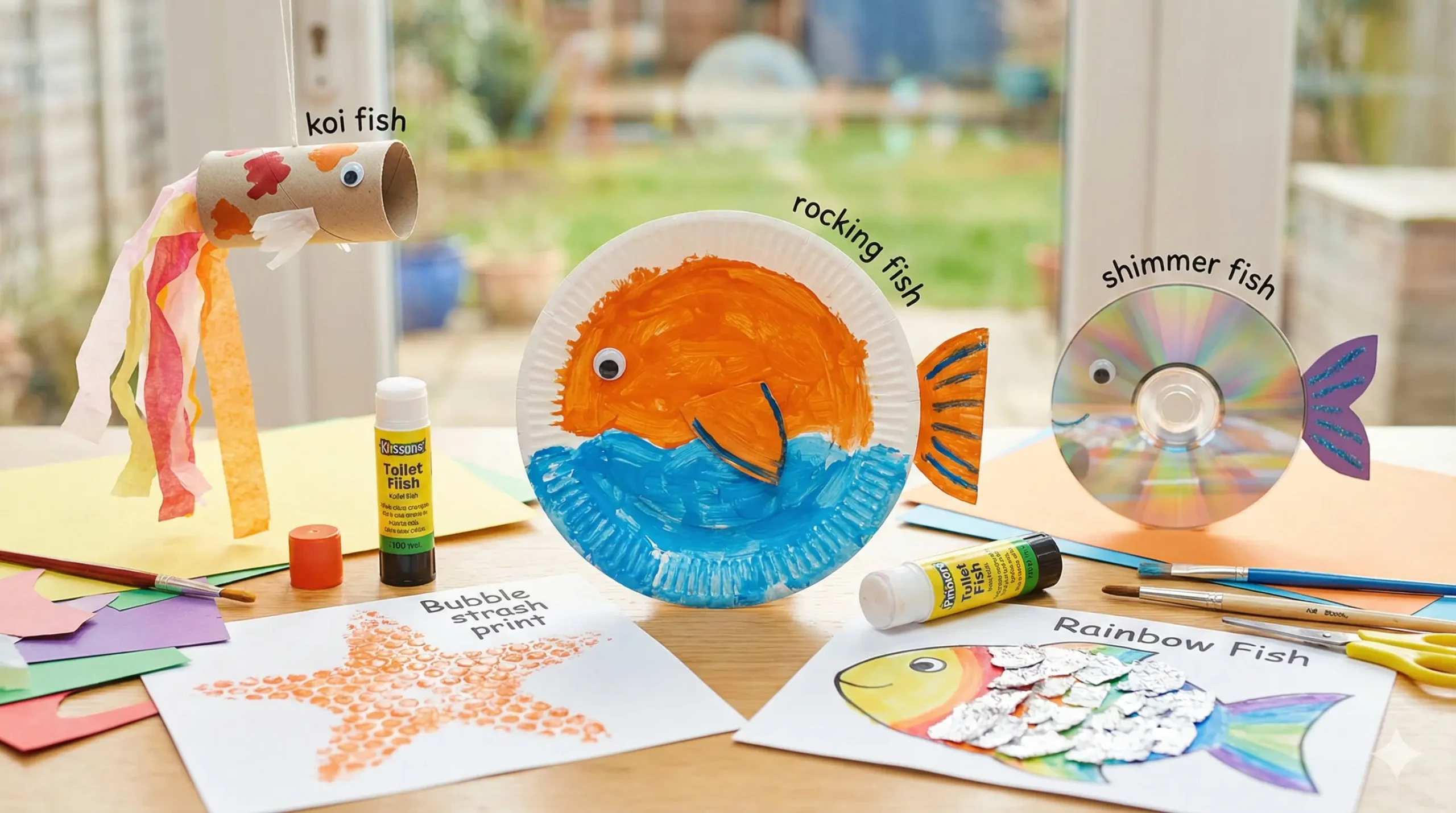
Fold a paper plate in half. This allows the fish to “rock” back and forth on the table. Let the kids paint the body in neon colors (pink, orange, and electric blue). Add a googly eye and a triangle tail cut from construction paper.
2. The Pufferfish Spike Craft
Use a smaller cake-sized paper plate. Have the kids paint it yellow or light brown. The fun part? Cutting strips of colorful paper or using soft pipe cleaners to stick off the plate in all directions, mimicking the spikes of a pufferfish.
3. The Mosaic Rainbow Fish
Inspired by Marcus Pfister’s famous book, The Rainbow Fish, this craft focuses on sharing and friendship. Cut small squares of colored paper and a few squares of aluminum foil. Have the child glue them onto the plate to create shimmering scales.
4. The Jellyfish Streamer
While technically not a fish, no ocean craft session is complete without them. Paint a bowl-shaped paper plate. Punch holes at the bottom and thread through long strands of yarn, ribbon, or bubble wrap to act as tentacles.
5. The “Mouth-Open” Shark
Cut a wedge out of the paper plate (like a slice of pizza). Don’t throw the wedge away—glue it to the back to make the tail! The empty space now looks like an open mouth. Glue jagged white paper teeth inside the rim for a ferocious predator.
Part 2: Recycled Materials Turned into Marine Life
Eco-friendly crafting is a great way to teach kids about keeping our oceans clean while making art.
6. Toilet Roll Koi Fish
Koi fish are famous for their resilience and patterns. Take an empty toilet paper roll and paint it orange or white with black splotches. Glue tissue paper streamers to one end to create a flowing tail that dances in the wind like a Japanese windsock (Koinobori).
7. Bottle Cap Fish Art
Don’t throw away those plastic bottle caps! Glue them onto a blue piece of cardstock. Add tiny googly eyes and draw bubbles coming out of them. It creates a 3D school of fish swimming together.
8. Egg Carton Whales
Cut out a single cup from an egg carton. Paint it blue. Poke a small hole in the top and insert a blue pipe cleaner to represent the water spout. Draw a smile, and you have a happy little whale.
9. CD Shimmer Fish
Old CDs and DVDs have a natural rainbow reflection. These make beautiful bodies for fish. Use sharpies to draw scales directly on the shiny side, and tape paper fins to the non-shiny side. Hang them in the window to catch the sunlight.
10. Bubble Wrap Starfish
Cut a starfish shape out of bubble wrap. Let the kids paint the textured side (the bubbly side) with orange or red paint. Then, press it down onto white paper to make a stamped print. The bubbles create a perfect “bumpy” texture that looks just like a real starfish.
Part 3: Developing Fine Motor Skills (Cutting and Folding)
These crafts are designed to help with dexterity and hand-eye coordination.
11. The Accordion Fold Fish
This is a classic technique. Take a long strip of colored paper and fold it back and forth like a fan. Fold the fan in half to create a circle fan shape—this becomes the body. Add a head and tail. This teaches precise folding skills.
12. Woven Paper Fish
Cut a fish shape out of cardstock and cut vertical slits in the middle (be sure not to cut all the way to the edge). Have the child weave strips of contrasting colored paper over and under through the slits. This is excellent for concentration and pattern recognition.
13. Handprint Goldfish
A messy favorite! Paint the child’s palm orange. Press it onto paper. The palm is the head, and the fingers are the tail fins. Once dry, draw on scales and an eye. These make wonderful keepsakes for grandparents.
14. Cupcake Liner Crabs
Flatten a red cupcake liner for the body. Fold two other liners in half for the claws. Glue them down and draw legs. The ruffled texture of the liners adds a great tactile element.
15. Pipe Cleaner Skeletons
For older kids, try twisting pipe cleaners together to create the outline of a fish. This is a bit like sculpting and requires patience to twist the wire ends together to form a shape.
Part 4: Themed and Educational Fish Crafts
Let’s connect the crafts back to the facts we learned earlier.
16. The “Jonah and the Whale” Puppet
Use a clothespin for this interactive craft. Draw a whale on paper and cut it in half horizontally. Glue the top half to the top clip of the clothespin and the bottom half to the bottom clip. Draw a tiny Jonah and glue him to the back side of the bottom clip. When you squeeze the clothespin, the whale’s mouth opens to reveal Jonah inside!
17. The Zodiac Pisces Sign
On a piece of black construction paper, use white chalk or silver star stickers to map out the Pisces constellation. Then, have the child draw the outline of the two fish around the stars. This connects astronomy with art.
18. Emotional Fish Masks
Since the Tiki masks of the Pacific (often associated with island culture and fishing) represent different gods and emotions, make fish masks! Cut large eye holes in a paper plate. Let the child decorate the fish to look “Happy,” “Angry,” or “Surprised.”
19. The Alphabet Fishing Game
Cut 26 simple fish shapes out of construction paper. Write a letter on each one. Attach a paperclip to the nose of each fish. Make a fishing rod using a stick, string, and a magnet. Scatter the fish on the floor and tell the child, “Catch the letter B!”
20. 3D Origami Fish
For the advanced crafter, try simple origami. A square piece of paper can be folded into a swimming fish without any cutting or gluing. This aligns perfectly with the Japanese culture of the Koi fish mentioned in the introduction.
Why Crafting is Essential for Development
Engaging in these “fantastic fish crafts” is about more than just killing time. It is a developmental workout for children.
- Sensory Processing: Handling glue, wet paint, crinkly foil, and soft feathers helps children process different textures.
- Patience and Focus: Waiting for paint to dry or threading a string requires a level of patience that is rare in our digital world.
- Scientific Curiosity: As you craft, you can ask questions: “Why do fish have scales?” “Why are some fish flat and others round?” This sparks a love for biology.
Conclusion
From the deep religious symbolism of the fish in ancient Syria to the simple joy of reading The Rainbow Fish before bed, these creatures are deeply embedded in our human story. By bringing them to life through art, we honor that connection.