We have all heard the question before. Perhaps we even asked it ourselves when we were sitting in a classroom, staring at a chalkboard filled with symbols: “Why do we have to learn this? When will I ever use integrals or algebra in real life?”
It is a fair question. To a child, complex mathematical concepts can feel abstract and disconnected from their daily reality of video games, playgrounds, and snacks. But here is the secret we need to share with them: Math is the language of the universe.
If it wasn’t for Math, we wouldn’t have the smartphones in our pockets, the video games on our screens, or the internet that allows you to read this article right now. This connection between numbers and the modern world is exactly why we celebrate Math 2.0 Day.
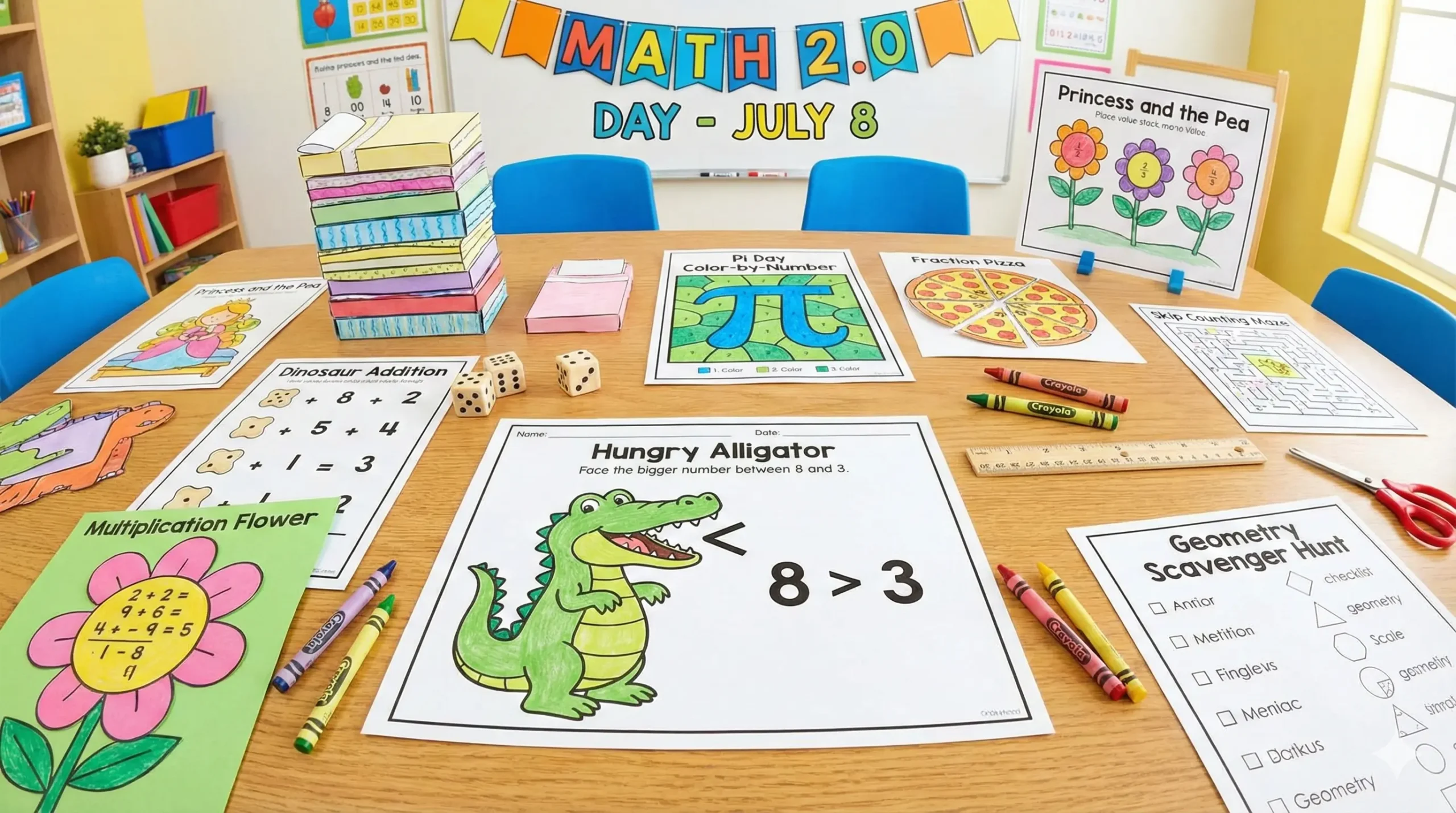
Math 2.0 Day falls on July 8th every year. Created by the Math Interest Group in 2009, this day celebrates the intersection of mathematics and technology. It is a reminder that math isn’t just about dusty textbooks; it is the engine driving our future.
Why Math Matters: Cool Facts to Share with Kids
Before diving into the activities, it helps to inspire children with stories of how math changed the world. Here are some fascinating discoveries made possible by numbers:
- The Pythagorean Theorem: This ancient concept isn’t just for triangles; it is foundational for architecture, construction, and even helping astronomers study the distance between planets.
- Johannes Kepler & Space Travel: Kepler used complex geometry to calculate the movement of comets and planetary orbits. Without his math, we could never launch a rocket to Mars!
- Isaac Newton & Gravity: Newton used mathematical calculations (specifically calculus) to prove the theory of gravitational attraction, explaining why we stay on the ground and why the moon orbits the Earth.
- Predicting the Weather: Edward Norton Lorenz created a mathematical formula that helps meteorologists forecast the weather. Next time you check if it’s going to rain, thank math!
- The First Computer Programmer: Ada Lovelace, a brilliant mathematician in the 1800s, realized that computers could do more than just calculate numbers. She is considered the world’s first computer programmer.
Now that we know why it matters, let’s make it fun! Below are 15 Magical Math Printables and Activity Ideas that cover everything from basic counting to geometry.
1. The Hungry Alligator: Greater Than or Less Than
Comparing numbers can be tricky for young learners. Which way does the symbol go? < or >?
- The Concept: Use a printable featuring an alligator with a wide-open mouth. The rule is simple: The alligator is hungry and always wants to eat the bigger number.
- Fun Fact: The equals sign (=) was introduced by Robert Recorde in 1557. Before that, mathematicians had to write out “is equal to” in words every single time. Imagine how long your homework would take!
2. Pi Day Color-by-Number
Whether it is Pi Day (March 14th) or Pi Approximation Day (July 22nd), the number Pi (3.14…) is a mathematical celebrity.
- The Activity: A color-by-number sheet where the answers to simple addition or subtraction problems reveal the symbol for Pi or a circular object (like a pie!). It helps kids associate the number with circles.
3. The Princess and the Pea: Place Value Stacks
Place value (ones, tens, hundreds) is a difficult concept to visualize.
- The Activity: Create a printable based on the fairy tale. The “mattresses” represent different values. A large base mattress represents hundreds, medium mattresses represent tens, and thin blankets represent ones. Kids have to stack them to reach a specific number to ensure the Princess can sleep!
4. 100th Day of School: Pixel Art Addition
The 100th day of school is a major milestone in elementary classrooms.
- The Activity: A grid containing 100 squares. Inside each square is a math problem (e.g., 5 + 5). The child solves the problem, and the answer corresponds to a specific color key. When finished, the 100 squares reveal a hidden picture.
- Fun Fact: The word ‘hundred’ comes from the Norse term ‘hundrath’. Ironically, in the ancient context, hundrath actually meant 120, not 100!
5. Dinosaur Addition Bones
Math has been around a long time—humans have been calculating on animal bones since 30,000 BC!
- The Activity: A printable featuring a T-Rex or Triceratops. The dinosaur is missing its spots or bones. The child rolls two dice, adds the numbers together, and draws that many “bones” or “spots” on the dinosaur. This combines history, dinosaurs, and mental math.
6. Skip Counting Mazes
Skip counting (2, 4, 6, 8…) is the foundation for multiplication.
- The Activity: A maze where the only way to get from the start to the finish is to follow the multiples of a specific number. For example, a “Save the Rabbit” maze where the rabbit can only hop on stones numbered 5, 10, 15, 20, etc.
7. Fraction Pizza Party
Fractions are often the first time kids feel “stuck” in math. Food makes it easier.
- The Activity: A printable paper pizza. Students “slice” the pizza (using scissors) into halves, quarters, and eighths. They can then “serve” orders. Example: “Customer wants 3/4 of a pepperoni pizza.” It turns abstract fractions into tangible objects.
8. Multiplication Flowers
Memorizing times tables can be boring rote learning. Let’s make it artistic.
- The Activity: A printable flower stem with a center circle. The center number is the multiplier (e.g., 7). The child draws 12 petals around the center. On the inner part of the petal, they write numbers 1-12. On the outer edge of the petal, they write the product (e.g., 7, 14, 21…). It creates a beautiful reference tool.
9. Geometric Shape Scavenger Hunt
Geometry is all about how shapes fit into our world.
- The Activity: A checklist printable featuring 2D and 3D shapes (Sphere, Cube, Cylinder, Cone). The child must walk around the house or classroom and find real-life objects that match the shapes, drawing them in the box. (e.g., A soup can for a Cylinder).
10. The “Missing Number” Bond Rainbows
Number bonds show how numbers split and combine (e.g., 10 is made of 6 and 4).
- The Activity: A printable rainbow. At the bottom of each arch are two clouds. The clouds must add up to the number at the top of the rainbow (usually 10 or 20). It’s a colorful way to visualize “making 10.”
11. Symmetry Butterflies
Symmetry is a key concept in geometry and art.
- The Activity: A printable featuring half a butterfly. The grid lines help the child draw the exact mirror image on the other side. Alternatively, for younger kids, they can paint one side, fold the paper in half while wet, and open it to see the symmetry magically appear.
12. Telling Time: The Daily Routine Clock
Digital clocks are everywhere, making analog clocks harder for modern kids to read.
- The Activity: Blank clock faces (circles with numbers but no hands). The child draws the hands to match specific times of their day: “Wake Up Time,” “Lunch Time,” and “Bedtime.” This connects the abstract concept of time to their personal life.
13. Money Market Shop
Calculations involving decimals and currency are vital life skills.
- The Activity: Printable “play money” (coins and bills) and a “Shop Menu” with items priced in various amounts. Kids have to “buy” items from the menu, count out the correct cash, and calculate the change required.
14. Graphing the Weather
Data collection and analysis are huge parts of Math 2.0.
- The Activity: A monthly bar graph printable. Each day, the child colors in a square corresponding to the weather (Sunny, Rainy, Cloudy, Snowy). At the end of the month, they analyze the data: “Which weather did we have the most of?”
15. Coordinate Plane Treasure Map
Introduction to algebra often starts with the X and Y axis.
- The Activity: A grid map (the coordinate plane) with islands, pirate ships, and treasure chests located at specific points. The child has to write down the coordinates (x, y) for each item. Example: “The Treasure is at (4, 2).”
Making Math Magical
The goal of these printables isn’t just to get the right answer; it is to build confidence. When a child realizes that solving a math problem can reveal a mystery picture, help a dinosaur, or slice a pizza, the fear of numbers disappears.
Math is not just about memorizing times tables; it is about logic, patterns, and understanding the world around us. By using these creative visual aids, you are setting your child up for a future where they don’t just do math—they enjoy it.