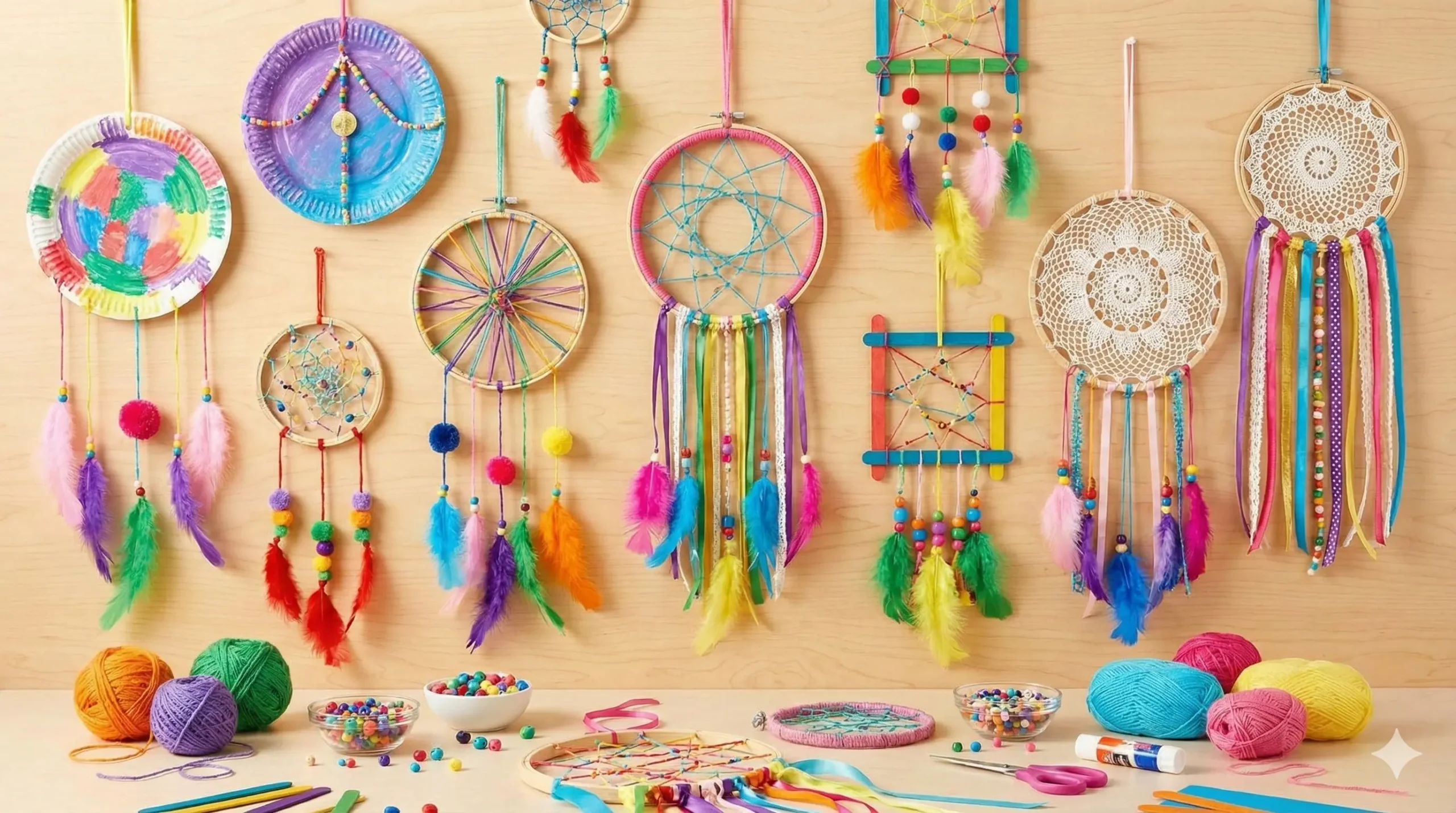
Do you remember the last dream you had? Maybe you were flying over a candy city, or perhaps you showed up to school in your pajamas! Whether they are silly, scary, or sweet, dreams are a huge part of our sleep.
With World Dream Day approaching (September 25th), there is no better time to talk to kids about their dreams—and how to keep the bad ones away. Enter the Dream Catcher.
This beautiful, traditional craft is more than just a bedroom decoration; it is a symbol of protection and comfort. If your little ones are prone to nightmares, or if you just want a fun, meaningful project to do together, making a DIY dream catcher is the perfect activity.
Below, we dive into the fascinating history behind these charms, the supplies you’ll need, and 10 creative DIY dream catcher ideas that are easy enough for kids to make!
What is a Dream Catcher? A Brief History
Before you break out the glue and glitter, it is wonderful to teach children the cultural significance of what they are making. Dream catchers are not just “crafts”; they are sacred charms with deep roots in Native American history.
The Legend of the Spider Woman
The dream catcher originated with the Ojibwe people. According to their legend, a spiritual protector known as the “Spider Woman” (Asibikaashi) took care of the children and the people of the land. As the Ojibwe nation spread to the corners of North America, it became difficult for her to reach all the children.
So, the mothers and grandmothers began weaving magical webs for the children, using willow hoops and sinew (or cordage). The purpose was simple but powerful:
- The Web: Catches the bad dreams (or “nightmares”) which get tangled in the net and disappear when the morning sun hits them.
- The Center Hole: Allows good dreams to pass through, sliding down the feathers to the sleeping child below.
Note: The Lakota tribe also has a dream catcher legend involving Iktomi (the teacher of wisdom), though in their version, the web often catches the good ideas while letting the bad ones fall away.
Meaning of the Parts
- The Hoop: Represents the circle of life and the sun’s daily journey across the sky.
- The Feathers: A soft ladder for good dreams to glide down gently.
- The Beads: Often represent the spider itself (the weaver of the web).
Essential Supplies Checklist
One of the best things about dream catchers is that they are great for using up scraps! Here is a basic list of what you will need:
- The Base: Embroidery hoops, paper plates, metal rings, or even recycled lids.
- The Web: Yarn, embroidery floss, twine, or thin ribbon.
- The Decoration: Feathers (craft or natural), wooden beads, pony beads, pom-poms, and sequins.
- Tools: Scissors, glue (school glue or hot glue for adults), and a hole punch.
10 DIY Dream Catchers for Kids
Here are ten distinct, easy-to-make styles ranging from simple paper plate crafts for toddlers to intricate designs for pre-teens.
1. The Classic Paper Plate Dream Catcher
Best for: Preschoolers and Toddlers
This is the ultimate starter craft. It helps young children practice fine motor skills like lacing without the frustration of complex knots.
- How to Make: Cut out the center of a paper plate, leaving just the sturdy rim. Punch holes around the edge (about 1-2 inches apart). Let your child weave yarn through the holes in a star pattern.
- Decoration: Punch three holes at the bottom and tie varying lengths of yarn. Let the kids string large pony beads and tie feathers to the ends.
2. The Nature-Lover’s Branch Catcher
Best for: Outdoor Education & Earth Day
Take the kids on a nature walk first! This project relies on natural materials, making it eco-friendly and unique.
- How to Make: Find a long, flexible green twig (willow or vine works best). Gently bend it into a circle and secure the ends with twine. Instead of a perfect web, wrap the twine randomly around the branch to create a rustic look.
- Decoration: Tuck small leaves, pinecones, or shells into the webbing.
3. The “No-Weave” Doily Dream Catcher
Best for: Kids who get frustrated with weaving
Weaving a symmetrical web can be tricky. This hack makes it look professional with zero effort!
- How to Make: Buy a small lace doily (often found at dollar stores). Use a wooden embroidery hoop that is slightly larger than the doily. Use string to tie the edges of the doily to the hoop, stretching it taut so it sits in the center like a spiderweb.
- Decoration: Lace ribbons and strips of fabric from the bottom for a “boho-chic” look.
4. The Magical Unicorn Dream Catcher
Best for: Fantasy lovers and Birthday Parties
Unicorns are timelessly popular. This variation turns the hoop into a unicorn’s face.
- How to Make: Wrap an embroidery hoop in white yarn until fully covered. Weave a simple web in pink or purple thread.
- The Special Touch: Cut felt ears (white and pink) and a glittery gold paper horn. Glue these to the top of the hoop. Add felt flowers around the base of the horn to hide the glue.
5. Popsicle Stick Hexagons
Best for: Classrooms and Groups
If hoops are too expensive, popsicle sticks are the answer.
- How to Make: Glue three popsicle sticks together to form a triangle, or six to form a hexagon. Paint them in bright colors. Wrap yarn around the sticks, crossing over to the opposite side to create a geometric web.
- Decoration: These look great with smaller beads and shorter yarn tails.
6. The Upcycled CD Dream Catcher
Best for: Teaching Recycling
Do you have scratched CDs lying around? Their shiny surface captures the light beautifully, acting as a “bad dream reflector.”
- How to Make: Use the CD as the center. Weave yarn through the center hole and around the outer edge (you may need to drill small holes or use hot glue to keep the yarn in place on the slippery edge).
- Decoration: The rainbow reflection of the CD does most of the work, so keep the tails simple with silver ribbons.
7. Mason Jar Ring Mini-Catchers
Best for: Quick gifts or Bag Charms
The metal ring from a mason jar lid is the perfect size for a mini dream catcher.
- How to Make: Because the ring is small, use thin embroidery floss instead of thick yarn. These are quicker to finish, making them great for kids with shorter attention spans.
- Decoration: These are small enough to be hung on a backpack zipper or a car rearview mirror!
8. Yarn-Wrapped Cardboard Circles
Best for: Sewing Practice
If you don’t have paper plates, an old cereal box works just as well.
- How to Make: Cut a ring out of sturdy cardboard. Wrap the cardboard entirely in thick, colorful wool so you can’t see the brown color underneath.
- The Web: Instead of punching holes, loop the web thread directly around the wool-wrapped ring. The friction of the wool holds the string in place.
9. The Giant Hula Hoop Catcher
Best for: A bold bedroom statement piece
Go big or go home! This uses a hula hoop as the base.
- How to Make: This is a group project. Wrap a hula hoop in fabric strips (t-shirt yarn works great). Because the hoop is huge, the “web” can be made of thick ribbon or chunky yarn.
- Decoration: Hang this on the wall above the bed. Use big, fluffy craft feathers and large wooden beads.
10. The Beaded “Spider” Catcher
Best for: Older kids (Ages 8+)
This version focuses on the legend of the spider.
- How to Make: While weaving the traditional web, thread a single, large black or shiny bead onto the string so it ends up near the center of the web.
- The Story: Tell the kids that this bead represents the spider who protects them at night. It’s a great way to make a spooky creature feel like a guardian!
Where Should You Place Your Dream Catcher?
Once the glue is dry, the placement is key for it to work its “magic.”
- Above the Bed: The traditional spot. It allows the good dreams to drip down the feathers right onto the sleeper.
- In the Window: Some believe the morning light needs to hit the dream catcher to burn away the bad dreams caught in the web.
- On the Bedroom Door: To “catch” any bad energy before it even enters the room.
Conclusion
Making a dream catcher is a labor of love. It requires patience, fine motor skills, and creativity. But the result is a beautiful, personalized talisman that can make bedtime a little less scary for young ones.