For many of us who grew up in the 90s, our first introduction to the majesty of the African continent was through the screen. I was 10 when The Lion King was released, and I was instantly hooked. I don’t remember how many times I rewatched it, but I know I could belt out “The Circle of Life” without missing a beat.
Beyond the catchy tunes and the lovable “bros”—Timon and Pumbaa—the movie introduced me to a gorgeous landscape that felt both magical and real. While my Swahili might still be limited to Hakuna Matata, my fascination with Africa has only grown deeper with age.
Now, as we introduce a new generation to these stories, it is the perfect time to go beyond the movies. Africa is a massive continent comprised of 54 countries, thousands of languages, and incredibly diverse cultures. The best way to teach children about this rich heritage is through hands-on learning: books and crafts.
Below, we have curated 15 traditional African crafts for kids that act as a gateway to learning about the people, art, and traditions of this vibrant continent. These projects are designed to be budget-friendly, educational, and, most importantly, fun!
Why Teach African Art to Kids?
Before we dive into the glue and scissors, it is important to understand the why. African art isn’t just about decoration; it is functional, spiritual, and deeply rooted in community.
- Cultural Appreciation: It helps children understand diversity and global cultures.
- Symbolism: Many African crafts communicate proverbs, history, or social status.
- STEAM Learning: These crafts often involve geometry, physics (sound waves in instruments), and engineering.
15 African Crafts to Make at Home or School
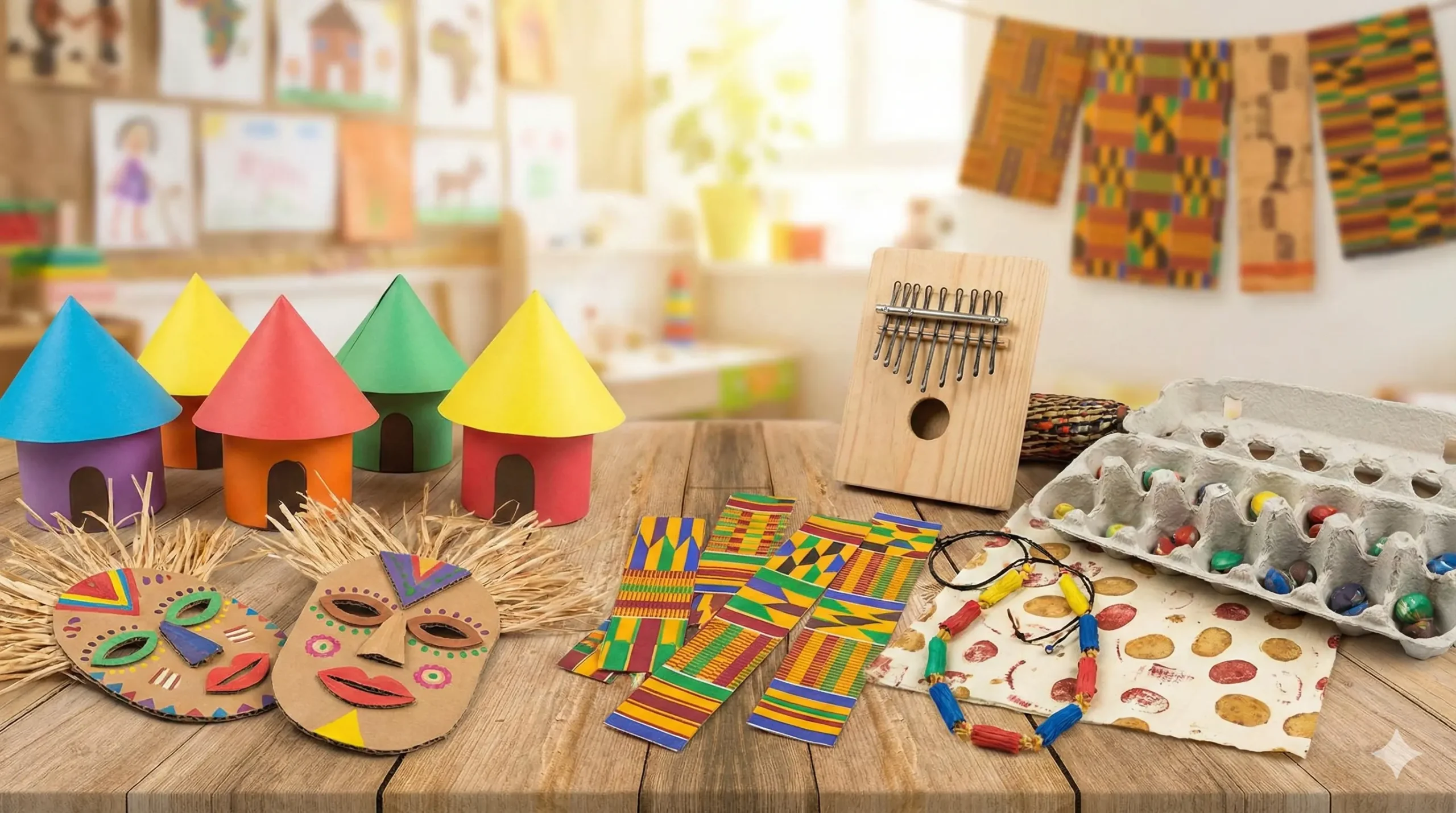
1. The Paper Cone Village Hut
In many rural parts of Africa, traditional round houses (often called Rondavels) are built using local materials like mud and thatched grass. Their round shape is aerodynamic and keeps the interior cool.
- What You Need: Cardstock or stiff paper, markers/crayons, glue, scissors.
- How to Make It: Cut a large circle for the roof and a wide rectangle for the walls. Decorate the walls with geometric patterns (simulating mud designs) and the roof with lines (simulating straw). Roll the rectangle into a cylinder and the circle into a shallow cone. Glue them together to create a village scene!
2. Tribal Ritual Masks
Masks are perhaps the most famous form of African art. Used in rituals in West and Central Africa, they represent ancestors, spirits, or animals. They are rarely used just for decoration; they are active tools for storytelling.
- What You Need: Cardboard or paper plates, paint, raffia (or yarn), scissors, glue.
- How to Make It: Cut an oval shape from cardboard. Cut out eye and mouth holes. Use earthy tones (browns, reds, ochre) to paint the base. Add distinct markings using white or black paint to represent scarification or tribal patterns. Attach raffia or yarn to the sides to simulate hair or a beard.
3. DIY Thumb Piano (Mbira)
Originating from the Shona people of Zimbabwe, the Mbira (often called a thumb piano) creates beautiful, bell-like tones. This is a fantastic physics lesson on vibration!
- What You Need: A small wooden board or sturdy cardboard box, bobby pins, duct tape.
- How to Make It: Secure the bobby pins to the board using strong tape. Pull the open ends of the pins up slightly so they can vibrate when plucked. Experiment by pulling the pins further out or pushing them in to change the pitch.
4. Kente Cloth Paper Weaving
Kente cloth, originating from the Ashanti people of Ghana, is a royal fabric known for its vibrant colors and complex patterns. Each color has a meaning (e.g., Gold = wealth, Green = growth).
- What You Need: Construction paper (Yellow, Green, Red, Black), scissors, glue.
- How to Make It: Cut a sheet of black paper into strips, leaving one end attached (creating a loom). Cut strips of red, yellow, and green paper. Teach kids to weave the colored strips “over and under” the black strips. This is excellent for fine motor skills!
5. Maasai Color Wheel Necklaces
The Maasai people of Kenya and Tanzania are world-renowned for their intricate beadwork. The stiff, flat collar necklaces are worn by women, and the color combinations tell a story about the wearer.
- What You Need: Paper plates, pasta shells or beads, bright paint, ribbon.
- How to Make It: Cut the center out of a paper plate to create a ring. Cut a slit in the back so it can be put around a neck. Have the children paint distinct rings of color (Red, Blue, Yellow, White) or glue colored pasta in concentric circles to mimic the beadwork.
6. Adinkra Potato Stamping
Adinkra symbols come from the Akan people of Ghana. These symbols represent concepts or aphorisms (like “Gye Nyame” which means “except for God”).
- What You Need: Potatoes (cut in half), carving tools (plastic knives), fabric paint, plain t-shirt or paper.
- How to Make It: Carve simple geometric shapes into the flat side of a potato. Dip the potato into fabric paint and stamp it onto the material to create a repeated pattern, just like traditional block printing.
7. Egyptian Cartouche Bookmarks
Moving to North Africa, we look at Ancient Egypt. A Cartouche is an oval with a horizontal line at one end, indicating that the text enclosed is a royal name.
- What You Need: Gold cardstock, black markers, a printout of the Hieroglyphic alphabet.
- How to Make It: Cut the cardstock into a long oval. Have the child translate their name into Hieroglyphics and draw it in the center. Punch a hole at the top and add a tassel.
8. Recycled Rain Sticks
Rain sticks are traditionally made from dried cactus and used in ceremonies to encourage rainfall. They are common in various indigenous cultures, including parts of Africa and South America.
- What You Need: Long cardboard tube (paper towel roll), aluminum foil, rice or dried beans, tape.
- How to Make It: Coil a long piece of aluminum foil into a spring and insert it into the tube. Seal one end of the tube with paper and tape. Pour in a handful of rice. Seal the other end. Decorate the outside with tribal designs. When tilted, the rice hits the foil, sounding like falling rain.
9. Ndebele Dolls
The Ndebele people of South Africa are famous for their colorful homes and doll-making. Traditional dolls are made to mark varied stages in a woman’s life.
- What You Need: Wooden clothespins or empty water bottles, colorful pipe cleaners, beads, fabric scraps.
- How to Make It: Wrap the “body” (bottle or clothespin) in colorful fabric. Use pipe cleaners to create the distinct golden neck rings often worn by Ndebele women. Use black beads for eyes.
10. Tinga Tinga Art
Named after Edward Saidi Tingatinga, this painting style from Tanzania uses brilliant, highly saturated colors and often features surreal animals.
- What You Need: Black paper, bright neon paints (acrylic works best).
- How to Make It: On the black background, have children paint African animals (giraffes, birds, leopards) using dots and spots. The key is to use the brightest colors possible to make them “pop” against the dark background.
11. Mancala Game Board
Mancala is one of the oldest board games in the world, with evidence of it being played in Aksumite Ethiopia thousands of years ago. It is a game of strategy and counting.
- What You Need: An empty egg carton (12 holes), two small bowls, dried beans or pebbles.
- How to Make It: Cut the lid off the egg carton. The 12 cups are the playing field. Place a bowl at each end (these are the “stores”). Paint the carton in earthy tones. You now have a fully functional game board to play the classic game of “sowing seeds.”
12. Safari Binoculars
While not a “traditional” craft, this is a rite of passage for any child learning about the African Savannah and its wildlife.
- What You Need: Two toilet paper rolls, tape/glue, yarn, stickers/paint.
- How to Make It: Glue the two rolls together side-by-side. Punch holes on the outside edges to attach the yarn (neck strap). Decorate with animal prints (leopard spots or zebra stripes). Take them outside and look for birds!
13. African Djembe Drum
Music is the heartbeat of Africa. The Djembe is a goblet-shaped drum from West Africa meant to be played with bare hands.
- What You Need: Two styrofoam cups or a plastic planter, duct tape, heavy paper.
- How to Make It: Cut the bottom out of one cup and tape it to the bottom of the other cup (creating an hourglass shape). Cover the top opening with heavy paper or a stretched balloon and secure tightly with tape. Decorate the body of the drum.
14. Batik Crayon Resist Art
Batik is a method of dyeing cloth using wax-resist techniques, popular in many African countries like Nigeria. We can simulate this safely with crayons.
- What You Need: White paper or white cotton fabric, white crayons, watercolor paints.
- How to Make It: Draw a design firmly using the white crayon. It will be invisible at first. Then, paint over the entire paper with watercolors. The paint will soak into the paper but “resist” the wax crayon, revealing the white design magically.
15. Handmade Paper Beads
In Uganda, artists create stunning jewelry from recycled magazines. This is a perfect “trash to treasure” craft.
- What You Need: Old magazines (glossy pages), glue, toothpicks, clear nail polish (optional).
- How to Make It: Cut long, thin triangles from the magazine pages. Start at the wide end of the triangle and roll it tightly around a toothpick. Glue the tip down. Once dry, slide it off the toothpick. You can varnish it with clear nail polish for shine. String them together for a bracelet!
Further Reading: Books About Africa for Kids
Crafts are wonderful, but pairing them with a story creates a lasting memory. Here are some incredible books to read while your glue dries:
- Too Small Tola by Atinuke – A delightful collection of stories about a small girl with a big heart living in Lagos, Nigeria.
- Africa, Amazing Africa: Country by Country by Atinuke – A non-fiction celebration of the distinct cultures, geography, and wildlife of the continent.
- The Water Princess by Susan Verde – A beautiful story based on the childhood of model Georgie Badiel in Burkina Faso.
- Deep in the Sahara by Kelly Cunnane – A poetic look at the culture and clothing of Mauritania.
- Ayo’s Adventure: Across the African Diaspora by Ain Heath Drew – A journey that connects African heritage with the wider world.
Final Thoughts: The Circle of Learning
Engaging in these African crafts for kids is about more than just keeping little hands busy. It is an opportunity to open a dialogue about a continent that is often misunderstood or generalized.
Whether you are building a village hut, weaving a Kente pattern, or playing a rhythm on a homemade drum, you are participating in a celebration of human ingenuity and culture. So, gather your materials, put on the Lion King soundtrack, and get ready to make something beautiful!