t is one of the few questions that transcends generations. Whether you grew up watching on a fuzzy box TV in the 1970s or your children are streaming it on a tablet today, the answer remains the same: You get there through imagination, kindness, and a little bit of learning.
Many childhood experiences are unique to specific eras. I know that only Millennials will understand the struggle of a scratched CD Walkman or blowing into a game cartridge. However, it is incredible that there is one cultural phenomenon that has enthralled kids from Generation X all the way to Generation Alpha.
We are talking, of course, about Sesame Street.
As one of America’s longest-running children’s shows, it has evolved over the decades, yet the core characters remain timeless. Whether your favorite is the chaotic energy of Cookie Monster, the sweetness of Elmo, or the lovable grumpiness of Oscar the Grouch, there is a muppet for everyone.
With Sesame Street Day celebrated on November 10th, Elmo’s birthday on February 3rd, and Cookie Monster’s big day on November 2nd, there is never a bad time to get crafty.
Below, we explore the history of the show and dive into 15 super fun Sesame Street crafts that help develop fine motor skills while celebrating these beloved characters.
The Amazing History: How Sesame Street Began
Before we break out the glue sticks and googly eyes, it is worth sharing a little history with your kids. It makes the activity more than just a craft—it becomes a lesson!
In the mid-1960s, nearly every home in America had a television set. Children were watching over 25 hours of TV a week, but much of the content was violent or simply mind-numbing cartoons. This led Joan Ganz Cooney, a producer for Channel 13, to ask a revolutionary question: Could television be used to actually educate children?
The answer was a resounding “Yes.”
Fun Facts to Share While Crafting:
- The Original Name: The show was almost called “123 Avenue B.” It was changed because it sounded too much like a specific location in New York City.
- Open Sesame: The name “Sesame Street” was chosen because the phrase “Open Sesame” from Ali Baba and the Forty Thieves implies opening a door to a place where magic and treasures happen.
- The Premiere: The very first episode aired on November 10, 1969. This is why we celebrate Sesame Street Day on this date every year.
Now that we know the history, let’s make some magic of our own!
Part 1: Paper Plate Muppets (The Classics)
Paper plates are the holy grail of toddler crafting. They are cheap, sturdy, and already the perfect shape for a Muppet’s face.
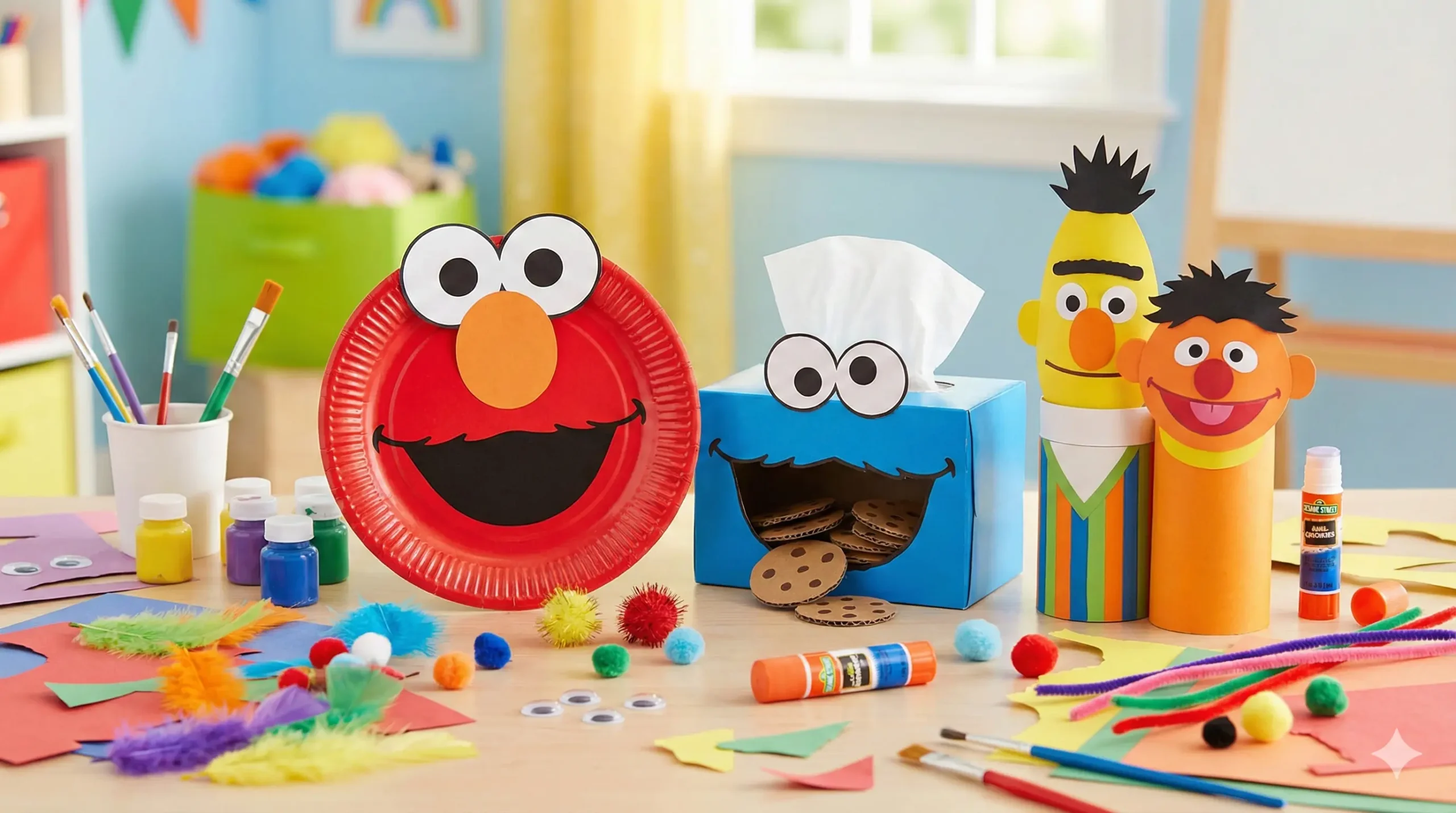
1. The Classic Elmo Face
Elmo is arguably the most popular monster on the street.
- What you need: Paper plate, red paint, orange pom-pom (nose), black paper (mouth), and two large white circles (eyes).
- The Method: Paint the entire plate bright red. Once dry, glue the eyes at the very top rim of the plate. Place the orange pom-pom nose directly under the eyes, and a large smiling black semi-circle for the mouth.
- Educational Angle: Use this to teach the color red and the concept of “happy” emotions.
2. Cookie Monster’s “Feed Me” Box
This isn’t just a craft; it’s a game!
- What you need: An empty tissue box, blue paint, blue construction paper, and “cookies” cut from cardboard.
- The Method: Paint the tissue box blue. The opening of the tissue box serves as the mouth. Add big googly eyes on top. Cut out circles from brown cardboard and draw chocolate chips on them.
- The Activity: Have your child count the cookies as they feed them into the box. “Om nom nom, one cookie! Om nom nom, two cookies!”
3. Big Bird’s Feathery Friend
Big Bird is tall, yellow, and full of questions.
- What you need: Yellow paper plate, yellow craft feathers, orange construction paper (beak), and pink paper (eyelids).
- The Method: This is a sensory craft. Cover the plate in glue and let your child stick yellow feathers all over it. The texture is fantastic for little hands. Add a triangular orange beak and the sleepy pink eyelids to capture his gentle nature.
4. Oscar the Grouch’s Trash Can
- What you need: A tin can (clean, with no sharp edges) or a grey plastic cup, green pompoms or green yarn.
- The Method: If using a cup, paint it silver to look like a trash can. Create a “messy” ball of green yarn or pompoms to peek out of the top. Add a unibrow made of brown felt to give him his signature grumpy look.
5. Zoe’s Ballerina Tutu Plate
Zoe loves to dance!
- What you need: Orange paint, tulle fabric or ribbon, gems/stickers.
- The Method: Paint the plate orange for Zoe. Glue a little skirt of tulle at the bottom of the plate and let your child decorate her “hair” with plastic gems or bows.
Part 2: Recycled Materials & Cardboard Rolls
Save those toilet paper rolls and kitchen towel tubes! They are perfect for creating standing figures.
6. Bert and Ernie Buddy Tubes
You can’t have one without the other.
- The Craft: Use a shorter toilet roll for Ernie and a longer kitchen roll tube for Bert.
- The Details: Paint Ernie orange and Bert yellow. The key distinctive feature is the hair. Use black yarn for Bert’s spiky hair and a tuft of black felt for Ernie. Don’t forget Bert’s signature unibrow!
- Lesson: Discuss friendship and how two very different people can be best friends.
7. The Yip Yips (Martians)
Remember the aliens that go “Yip yip yip, uh-huh, uh-huh”? They are incredibly easy to make.
- The Craft: Take a colored sock or a piece of fabric draped over a cardboard tube. Cut a slit for the mouth and add pipe cleaners sticking out of the top as antennae.
- Fun Factor: These make hilarious puppets.
8. Abby Cadabby’s Magic Wands
- What you need: A chopstick or dowel, pink and purple ribbon, cardstock stars.
- The Method: Cut a large star out of cardstock and let the child glitter it heavily. Glue it to the stick. Tie long strands of pink and purple ribbon to the base of the star so they flow when waved.
- Magic Word: Teach your child to say “Zazzy!”
9. Count von Count’s Number Rocks
The Count loves to count!
- The Craft: Go on a nature walk and collect smooth rocks. Paint them purple.
- The Activity: Paint numbers (1, 2, 3…) on the rocks in white paint. On the back, paint the Count’s face (monocle and fangs). This is a great math manipulative for preschoolers.
10. Super Grover’s Mask
- What you need: Blue paper plate or felt, elastic string, pink felt.
- The Method: Cut eye holes in a blue plate. Glue a pink nose. But the most important part is the helmet! Cut a helmet shape from silver foil or grey paper and glue it to the top.
- Action: Now your child can run around saving the day as Super Grover 2.0!
Part 3: Sensory and Educational Crafts
Sesame Street is researched-based education. These crafts focus on sensory processing and learning.
11. Dorothy’s Fish Bowl (Sensory Bag)
Elmo loves his goldfish, Dorothy.
- The Craft: Take a heavy-duty Ziploc bag. Fill it with clear hair gel and a little blue food coloring. Add a small orange foam fish cutout inside. Tape the bag shut (and tape it to a table or window).
- The Play: Children can push the gel around to make Dorothy swim without making a mess.
12. Cookie Monster Playdough
- Recipe: Make a standard homemade playdough batch but use intense blue food coloring.
- Add-ins: Mix in brown buttons or painted brown beans to represent “chocolate chips.”
- Goal: It strengthens hand muscles which helps with writing later in school.
13. The “Letter of the Day” Sign
- The Craft: Use popsicle sticks to create a frame. Decorate it with glitter and stickers.
- Usage: Every morning, write a letter on a piece of paper and clip it to the frame. Ask your child, “What is the letter of the day?” just like on the show.
14. Mr. Snuffleupagus Wool Art
Snuffy is big and shaggy.
- The Craft: Draw a large outline of a mammoth/elephant shape. Give your child brown yarn cut into small pieces.
- The Method: Cover the drawing in glue and have the child stick the yarn on. It creates a fuzzy texture that mimics Snuffy’s fur.
15. Rubber Ducky Bath Time Boats
“Rubber Ducky, you’re the one!”
- The Craft: Use pool noodle slices cut in half. Stick a small triangle sail (made of foam sheet and a toothpick) into the noodle.
- The Fun: These float perfectly in the bath, making bath time as fun for your kids as it is for Ernie.
Why Crafting with Sesame Street Matters
You might wonder, why spend time making these specific characters?
1. Emotional Connection: Children learn best when they are interested. Because they already love Elmo and Big Bird, they are more likely to engage in the activity for longer periods.
2. Social-Emotional Learning: Sesame Street is famous for teaching feelings. When you make an “Oscar” craft, you can talk about being grumpy and how to handle it. When you make a “Big Bird” craft, you can talk about making mistakes and asking questions.
3. Fine Motor Skills: Cutting, gluing, painting, and gripping small items like googly eyes are essential for developing the dexterity needed for writing, buttoning shirts, and tying shoelaces.
Conclusion
Whether you are celebrating the 55th Anniversary of the show, throwing a birthday party, or just looking for a way to keep your toddler busy on a rainy Tuesday, these Sesame Street crafts for kids are the perfect solution.