Sometimes, we look back at our school days and ask ourselves, “Why did I need to learn that?” When staring at a page full of integrals, differentials, and complex algebra, it’s easy to wonder if we will ever use these concepts in “real life.”
But the truth is, if it weren’t for Math, you wouldn’t be reading this article right now. You wouldn’t have a smartphone, a computer, or even the internet! Mathematics is the silent language that powers our modern world.
To celebrate the importance of numbers in technology, the Math Interest Group created Math 2.0 Day in 2009. Celebrated annually on July 8th, this day reminds us that math isn’t just about boring drills; it’s the foundation of innovation.
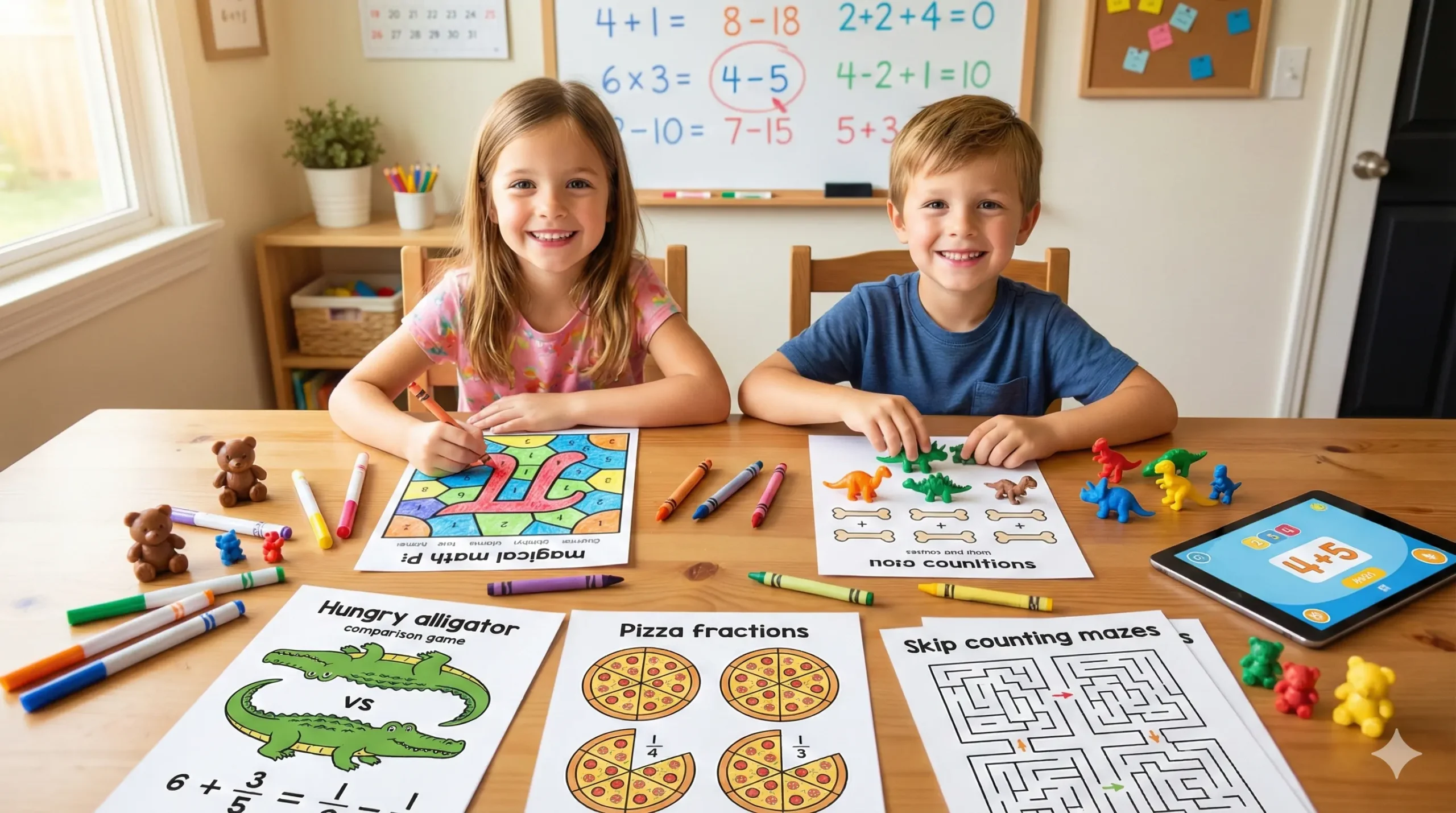
However, we know that getting kids excited about numbers can be a challenge. That is why we have curated a list of 15 Magical Math Printables for Kids. Whether your child is struggling with basic addition, wrestling with fractions, or navigating place values, these fun, creative, and free-to-use ideas will turn “math time” into “playtime.”
Why Math Matters: Cool Facts to Share with Kids
Before you fire up the printer, sit down with your kids and share why math is so cool. It’s not just about getting good grades; it’s about discovering how the universe works. Here are some fascinating discoveries made possible by math:
- Space Travel: Johannes Kepler used complex math to calculate the movement of comets and planetary orbits. Without him, we wouldn’t understand our solar system!
- Gravity: Sir Isaac Newton used mathematical calculations to prove the theory of gravitational attraction.
- Your Weather App: Ever wonder how we know it’s going to rain? Edward Norton Lorenz created a mathematical formula that helps meteorologists forecast the weather.
- Computer Programming: Ada Lovelace, a brilliant mathematician, is considered the world’s first computer programmer. She realized that numbers could represent more than just quantities—they could represent music and letters, too!
- Electricity: James Clerk Maxwell used just four equations to create the Dynamical Theory of the Electromagnetic Field, paving the way for the electricity we use today.
Now that we know how powerful math is, let’s dive into the fun stuff!
15 Magical Math Printables to Spark Joy
Here are 15 creative printable ideas and activities. You can find versions of these online or easily create them yourself using simple drawing tools or Canva.
1. The “Hungry Alligator” Number Comparison
Comparing numbers (Greater Than vs. Less Than) can be confusing for little ones. Enter the Hungry Alligator!
- The Concept: The alligator always wants to eat the bigger number.
- The Printable: Print out a cute green alligator head with its mouth open wide. Use this visual to teach the < and > symbols.
- Fun Fact: Did you know the equal sign = was introduced by Robert Recorde in 1557? Before that, equations were written out in words. Imagine writing “two plus two equals four” every single time!
2. Pi Day Color-by-Number
Whether it is Pi Day (March 14th) or Pi Approximation Day (July 22nd), the number Pi (3.14…) is legendary.
- The Printable: A complex mandala or spiral design where every section corresponds to a digit of Pi. As kids color according to the code, they reveal a beautiful pattern.
- Why it works: It combines art with number recognition, helping the brain relax while focusing on digits.
3. Princess and the Pea: Place Value Party
Archimedes of Syracuse is often called the father of mathematics, but he probably never imagined math combined with fairy tales!
- The Printable: A worksheet featuring a stack of mattresses. Each mattress represents a different place value (Ones, Tens, Hundreds).
- The Activity: Kids have to write the correct digits on the mattresses to help the Princess sleep. It’s a storytelling approach to understanding how numbers are built.
4. 100th Day of School Color-by-Addition
Reaching the 100th day of the school year is a huge milestone in elementary school.
- The Printable: A hidden picture puzzle. To find out what the picture is, the child must solve simple addition problems (e.g., 5+5=10, 50+50=100).
- Fun Fact: The word “hundred” comes from the Norse term ‘hundrath’. Ironically, in ancient times, hundrath actually meant 120, not 100!
5. Dinosaur Bone Addition
Math is ancient—humans have been calculating on animal bones since 30,000 BC!
- The Printable: A worksheet featuring dinosaur skeletons. The ribs or bones act as counters.
- The Activity: “The T-Rex has 3 bones, and the Stegosaurus has 4 bones. How many bones do they have together?” This appeals to visual learners and dino-obsessed kids.
6. The “Pizza Fraction” Circle
Fractions are often the first major stumbling block for students.
- The Printable: A set of printable pizzas sliced into halves, quarters, thirds, and eighths.
- The Activity: Kids can physically cut out the slices and rearrange them to see that two 1/4 slices are the same size as one 1/2 slice. Visualizing fractions makes them much less scary than just looking at numbers on a page.
7. Skip Counting Mazes
Skip counting (2, 4, 6, 8…) is the foundation for multiplication.
- The Printable: A maze where the only way to get from the “Start” to the “Finish” is to color in the boxes that follow a skip counting rule (e.g., counting by 5s).
- Why it works: It turns a repetitive drilling exercise into a puzzle-solving game.
8. Geometric Shape Scavenger Hunt
- The Printable: A checklist featuring 2D and 3D shapes (Sphere, Cube, Cylinder, Triangle).
- The Activity: Kids take the clipboard and run around the house or classroom finding real-world objects that match the shapes. A soup can is a cylinder; a ball is a sphere. This connects abstract geometry to the physical world.
9. Money Math Shop
- The Printable: Cut-out paper currency (coins and bills) and a “Menu” of items with price tags.
- The Activity: Set up a pretend shop. The child has to “buy” items and calculate the correct change. This teaches addition, subtraction, and the value of money simultaneously.
10. Multiplication Flower Wheels
- The Printable: A flower shape. The center of the flower has a number (e.g., 7). The inner petals have numbers 1-12.
- The Activity: The child writes the answer (the product) on the outer petals. For example, 7 x 2 = 14. It creates a beautiful flower of facts that acts as a reference guide.
11. Symmetry Butterfly Art
- The Printable: A drawing of half a butterfly on a grid.
- The Activity: The child must draw the other half of the butterfly, ensuring it is perfectly symmetrical. This improves spatial awareness and introduces the concept of lines of symmetry.
12. Telling Time: The “Daily Routine” Clock
- The Printable: Blank clock faces.
- The Activity: Kids draw hands on the clocks to represent key times in their day: “What time do you wake up?” “What time is lunch?” “What time is bedtime?” It personalizes the concept of time.
13. Graphing with Lego Bars
- The Printable: A blank bar graph grid labeled with colors (Red, Blue, Yellow, Green).
- The Activity: Give the child a handful of Legos or beads. They must sort them by color and then color in the graph to represent how many of each color they have. This introduces data handling and statistics.
14. Word Problem “Story Cards”
- The Printable: Flashcards with short stories rather than just equations.
- The Concept: “Sam has 5 apples. He gives 2 to his mom. How many does he have left?”
- Why it works: Many kids can do the math but struggle with the reading comprehension aspect. Story cards bridge that gap.
15. The “Mystery Number” Detective Case
- The Printable: A sheet with clues (e.g., “I am an even number,” “I am greater than 10 but less than 20,” “My digits add up to 5”).
- The Activity: The child uses logic and deduction to find the single number that fits all the criteria. It makes them feel like math detectives!
3 Tips for Using Math Printables Effectively
To get the most out of these resources, keep these tips in mind:
1. Make it Hands-On Don’t just hand a child a worksheet and walk away. Use manipulatives. If the printable is about addition, give them dry beans, buttons, or cereal pieces to count with. Physical objects help bridge the gap between concrete reality and abstract numbers.
2. Laminate for Longevity If you have a laminator (or clear sheet protectors), use them! This allows kids to use dry-erase markers on the printables. They can make mistakes, wipe them away, and practice again and again without wasting paper.
3. Keep it Positive Math anxiety is real. If a child gets stuck, don’t pressure them. These printables are meant to be “Magical,” not stressful. If a concept is too hard, move to a different activity and come back to it later.
Conclusion
Math doesn’t have to be a boring subject stuck inside a textbook. By using these 15 Magical Math Printables, you can bring numbers to life. From the history of Archimedes to the fun of counting dinosaur bones, there is a whole world of excitement waiting to be calculated.