Imagine a country with a nickname as beautiful as the ‘Rainbow Nation’. You would think the people living there would be cheerful and happy all the time, smiling, sharing, and helping each other regardless of who they are.
Unfortunately, for a long time, South Africa was anything but happy, despite having such a colorful nickname. The country was deeply divided along racial lines due to a system called Apartheid. Under these rules, people were treated differently based solely on the color of their skin.
But history changed because one man decided that enough was enough. His name was Nelson Mandela, affectionately known by his clan name, Madiba. He fought for equality, democracy, and peace, sacrificing his own freedom to ensure the freedom of others.
Today, Nelson Mandela is considered one of the 20th century’s most iconic leaders, standing tall alongside figures like Mahatma Gandhi and Martin Luther King Jr.
If you are looking for ways to teach your children or students about resilience, forgiveness, and leadership, there is no better subject than Mandela. Below, we explore his life and offer 10 engaging Nelson Mandela activities for kids.
Who Was Nelson Mandela? (A Child-Friendly Guide)
Before diving into the crafts and activities, it is helpful to set the stage.
Nelson Mandela was born in 1918 in a small village in South Africa. Here is a fun fact to start with: His birth name was ‘Rolihlahla Mandela’. In the Xhosa language, Rolihlahla literally means “pulling the branch of a tree,” but it colloquially translates to “Troublemaker”! It wasn’t until his first day of school that his teacher gave him the English name ‘Nelson,’ which stuck with him for the rest of his life.
Mandela grew up to become a lawyer and joined the African National Congress (ANC). He spent his life fighting against the unfair laws of Apartheid. Because of his protests, he was arrested and spent 27 years in prison.
Imagine being locked in a tiny cell, sleeping on a straw mat, and doing hard labor in a lime quarry for nearly three decades. Most people would become angry or bitter. But when Mandela was finally released in 1990, he didn’t want revenge. He wanted peace. He became South Africa’s first Black president in 1994 and worked to bring everyone together.
Important Timeline of Nelson Mandela’s Life
Understanding the timeline helps children grasp how long his struggle was. You can use these dates for a history project.
- 1918: Born into the Tembu tribe in Mvezo, South Africa.
- 1942: Qualified as a lawyer (one of the few Black lawyers in South Africa at the time).
- 1944: Joined the African National Congress (ANC) to fight for rights.
- 1962: Arrested and eventually sentenced to life imprisonment during the Rivonia Trial.
- 1964-1990: Imprisoned on Robben Island, Pollsmoor Prison, and Victor Verster Prison.
- 1990: Released from jail, marking the beginning of the end of Apartheid.
- 1993: Awarded the Nobel Peace Prize jointly with F.W. de Klerk.
- 1994: Elected as South Africa’s first democratically elected President.
- 2009: The UN declares July 18th as Mandela Day.
- 2013: Passed away, leaving behind a legacy of peace.
What is Mandela Day? (The “67 Minutes” Concept)
In 2009, the United Nations General Assembly declared that Mandela’s birthday, 18th July, would be observed as Nelson Mandela International Day.
The core idea of this day is the “67 Minutes” challenge. Since Nelson Mandela fought for social justice for 67 years, people around the world are asked to dedicate just 67 minutes of their time to helping others.
Now, let’s get into the activities!
10 Inspiring Nelson Mandela Activities for Kids
These activities range from arts and crafts to social-emotional learning tasks, perfect for home or the classroom.
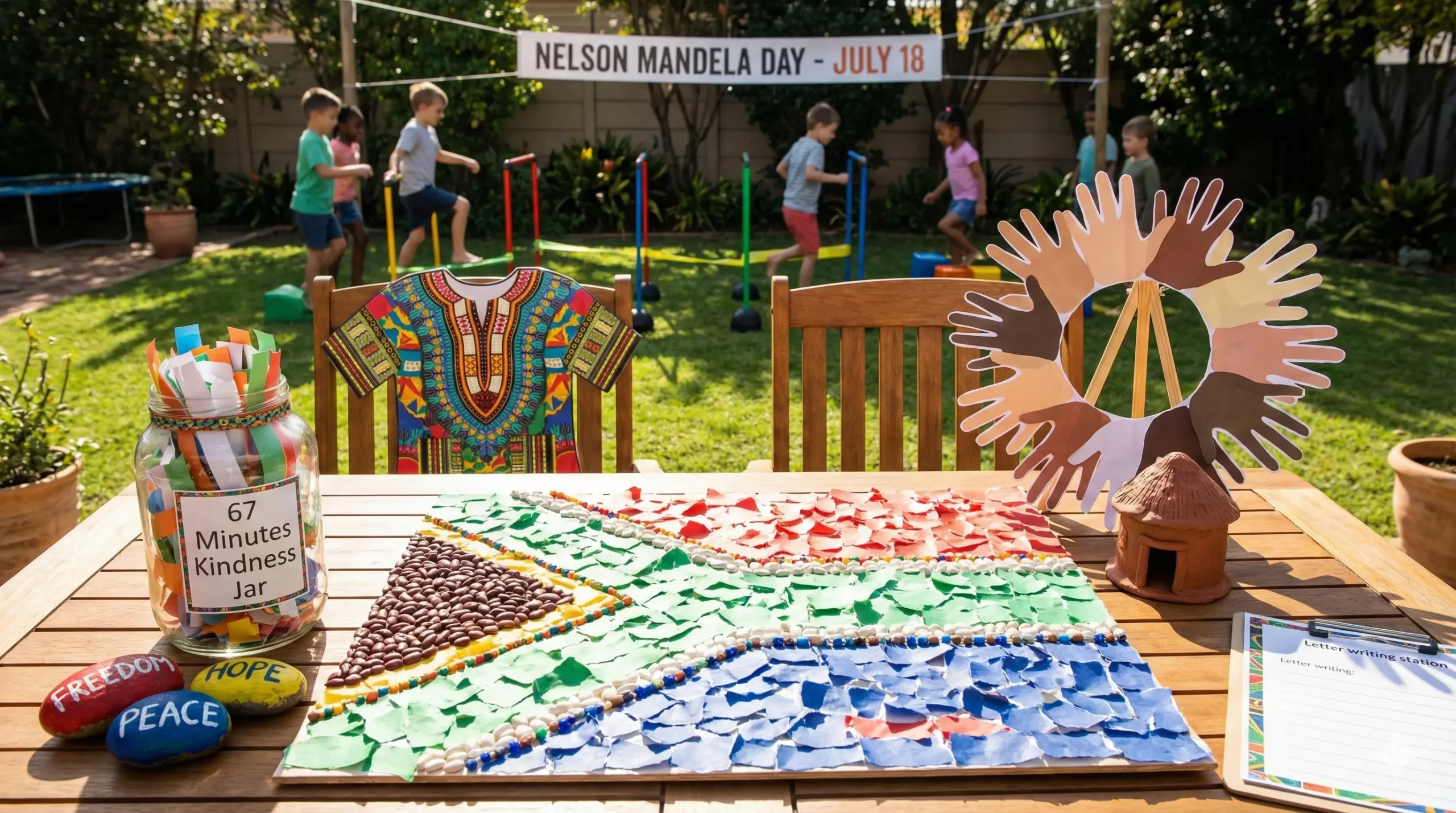
1. The “67 Minutes” Kindness Jar
This is the perfect way to honor the spirit of Mandela Day.
- The Activity: Decorate a glass jar with the South African flag colors. Cut out 67 strips of paper. On each strip, have your child write down a small act of kindness (e.g., “Help with dishes,” “Draw a picture for a neighbor,” “Pick up litter”).
- The Lesson: This teaches that service doesn’t have to be huge; small acts accumulate to create big change. Try to pull one strip out every day or do as many as possible on July 18th.
2. South African Flag Mosaic
The South African flag is the ultimate symbol of the “Rainbow Nation,” combining colors from the country’s various political history groups into a V-shape that symbolizes unity.
- The Activity: Draw the outline of the flag (Black triangle, yellow border, green Y-shape, white borders, red top, blue bottom). Instead of coloring it, use torn bits of colored paper, beads, or dried beans to fill in the sections.
- The Lesson: Discuss how the different colors coming together create something beautiful, just like different people coming together make a strong country.
3. Design a “Madiba Shirt”
Nelson Mandela was famous for not wearing stiff, grey suits. He loved wearing colorful, patterned silk shirts, which became known as “Madiba Shirts.”
- The Activity: Cut a t-shirt shape out of cardstock. Provide kids with bright markers, patterned washi tape, and stickers. Ask them to design a shirt that Mandela would have been proud to wear.
- The Lesson: This activity celebrates African heritage and the confidence to be yourself.
4. “Freedom Rocks” Painting
While in prison on Robben Island, Mandela was forced to work in a lime quarry, breaking rocks. It was hard, blinding work. We can flip this narrative to focus on hope.
- The Activity: Collect smooth river stones. Have the children paint them with bright colors and write words like “Freedom,” “Peace,” “Hope,” or “Love” on them. Place these rocks around your garden or a local park.
- The Lesson: Transforming something hard (the rock) into something beautiful represents Mandela’s ability to transform his suffering into forgiveness.
5. The “Long Walk to Freedom” Obstacle Course
Mandela wrote an autobiography called Long Walk to Freedom. His journey wasn’t easy; it had many barriers.
- The Activity: Set up a backyard obstacle course. Include a “tunnel” (representing prison), a “balance beam” (representing the negotiation for peace), and a finish line with a flag.
- The Lesson: Physicalizing the struggle helps younger kids understand that doing the right thing is often difficult and requires endurance, but the finish line is worth it.
6. Handprint of Unity Wreath
- The Activity: Have children trace their hands on paper of many different skin tones (brown, beige, black, tan, pink). Cut them out and glue them together in a circle or a wreath shape. You can write “Unity” in the center.
- The Lesson: This provides a visual representation of a non-racial society where everyone holds hands and works together.
7. Learn the “Nkosi Sikelel’ iAfrika”
This is part of the South African national anthem. It is a beautiful hymn.
- The Activity: Find a video online of the anthem being sung. Try to learn the first verse with your kids. The rhythm and harmony are distinct and moving.
- The Lesson: Music played a huge role in the anti-apartheid struggle. Singing in an African language (Xhosa/Zulu) helps connect kids to the culture Mandela loved.
8. The “Troublemaker” Comic Strip
Recall that his name, Rolihlahla, meant “Troublemaker.”
- The Activity: Ask your kids to draw a 3-panel comic strip.
- Panel 1: Someone sees something unfair (bullying, littering).
- Panel 2: The character decides to be a “good troublemaker” (intervening, speaking up).
- Panel 3: The situation is resolved.
- The Lesson: Teach kids that sometimes, you have to cause a little “trouble” (by speaking up) to make things right. This is called “Good Trouble,” a concept also championed by US civil rights leader John Lewis.
9. Build a Miniature Hut (Rondavel)
Mandela grew up in a village called Qunu, living in traditional round huts called rondavels.
- The Activity: Use clay, playdough, or cardboard to build a small round house with a conical roof. You can use dried grass for the roof thatch.
- The Lesson: Connects children to Mandela’s humble beginnings. It shows that great leaders can come from small villages.
10. Write a Letter to a Leader
- The Activity: Even though Mandela has passed away, ask children to write a letter to him. Ask them: “What would you tell Mandela about our world today?” or “What would you thank him for?”
- The Lesson: This encourages reflection and writing skills. It helps children articulate their feelings about justice and leadership.
Why It Matters
Teaching our children about Nelson Mandela is about more than just a history lesson. It is about teaching Emotional Intelligence.
Mandela showed the world that forgiveness is stronger than revenge. When he left prison, he could have been angry at the people who put him there. Instead, he invited his jailer to his inauguration. He brought a fractured country together through rugby, music, and dialogue.
By engaging in these crafts and activities, you are planting seeds of empathy, courage, and justice in the next generation.
“Education is the most powerful weapon which you can use to change the world.” – Nelson Mandela