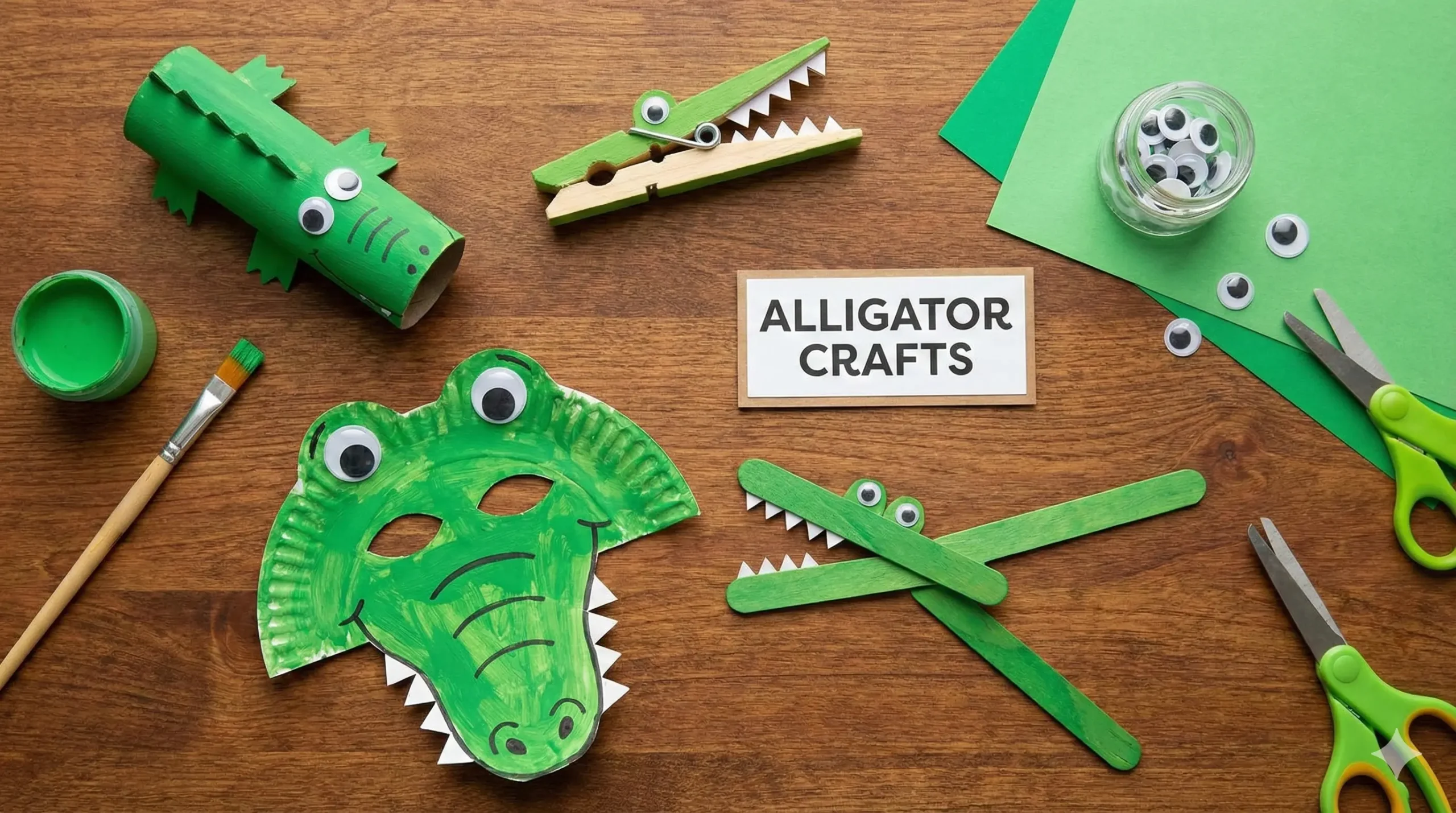
Have you heard the snap? National Alligator Day is coming up on May 29th, and it is the perfect excuse to get messy, creative, and educational with your little ones.
You have probably heard that cats and lions belong to the same family. Naturally, most people assume that alligators and crocodiles are, at the very least, cousins! However, you might be surprised to know that they are from different families within the order Crocodilia.
While they look similar to the untrained eye, these ancient reptiles are fascinatingly different. Before we dive into our list of 10 Amazing Alligator Crafts, let’s turn this craft session into a mini-science lesson.
Alligators vs. Crocodiles: What’s the Difference?
If you want to impress your kids (or your students), here is how to tell these two apart. It is a great conversation starter while you are waiting for the paint to dry!
- The Snout Shape: This is the easiest giveaway. An alligator has a broad, U-shaped snout (like a shovel), whereas a crocodile has a narrow, V-shaped snout.
- The Smile: When an alligator closes its mouth, you usually can’t see its teeth. However, when a crocodile shuts its mouth, the fourth tooth on the lower jaw sticks out over the upper lip, giving it a “toothy” grin.
- Color Coding: Alligators are generally darker, often appearing black or dark gray to blend into mud. Crocodiles are typically lighter, with a grayish-green or olive hue.
- Home Sweet Home: Alligators love freshwater (swamps, rivers, lakes). Crocodiles have special glands that allow them to tolerate saltwater, so you find them in estuaries and mangroves.
- Temperament: While you definitely shouldn’t high-five either of them, crocodiles are known to be much more aggressive than alligators.
Now that we are experts on the subject, let’s celebrate these incredible creatures (who are descendants of the dinosaur Deinosuchus!) with some arts and crafts.
10 Amazing Alligator Crafts for Kids
We have curated a list of crafts using recycled materials like cardboard tubes, clothespins, and egg cartons. These are perfect for preschoolers, kindergarteners, and early elementary students.
1. The Classic Cardboard Tube Alligator
This is the quintessential recycled craft. It’s eco-friendly and results in a sturdy toy.
- Materials: Empty toilet paper roll, green paint, scissors, googly eyes, white paper (for teeth).
- How to Make It:
- Paint the cardboard tube green inside and out. Let it dry.
- Cut a “V” shape out of one end of the tube to create the open mouth.
- Cut a zigzag strip of white paper and glue it inside the mouth to represent sharp teeth.
- Glue two large googly eyes on top of the head (near the mouth).
- Pro Tip: You can cut the other end of the tube into a point to make the tail!
2. Clothespin “Snapping” Gators
This craft is interactive! It helps toddlers and preschoolers develop fine motor skills by pinching the clothespin.
- Materials: Wooden clothespins, green marker or paint, green pipe cleaners, small googly eyes.
- How to Make It:
- Color the entire wooden clothespin green.
- Glue a strip of red felt or paper inside the “mouth” (the clipping part) for the tongue.
- Glue two tiny eyes near the metal spring.
- Bend a green pipe cleaner into a zigzag shape and glue it to the top of the clothespin to look like the bumpy scales on an alligator’s back.
- Pinch the end, and watch your alligator snap!
3. The “Greater Than” Math Alligator
Alligators are a fantastic tool for teaching math concepts. Teachers have used the “Alligator Mouth” to teach “Greater Than” ($>$) and “Less Than” ($<$) for decades because the alligator always wants to eat the bigger number!
- Materials: Green popsicle sticks, white foam (teeth), glue.
- How to Make It:
- Take two green popsicle sticks and glue them together at one end to form a “V” shape.
- Cut small white triangles from foam or paper and glue them along the inside of the “V”.
- Use this physical tool during homework. Place two numbers on the table and ask the child to face the alligator mouth toward the larger number.
4. Bubble Wrap Textured Alligator
Alligators have rough, bumpy skin called scutes. Bubble wrap is the perfect material to mimic this texture.
- Materials: Bubble wrap, green paint, cardstock, paintbrush.
- How to Make It:
- Cut a sheet of bubble wrap into the shape of an alligator (long body, tail, four legs).
- Have the child paint the bumpy side of the bubble wrap with different shades of green and brown.
- Press the painted bubble wrap onto a piece of white paper like a stamp.
- Peel it back to reveal a cool, scaly texture! Add eyes and teeth once the paint dries.
5. Egg Carton Alligator Train
This craft creates a long, 3D alligator that can wiggle.
- Materials: An empty cardboard egg carton, green paint, ribbon or string, googly eyes.
- How to Make It:
- Cut the egg carton cups apart. You will need about 4-6 cups.
- Paint all the cups green.
- Punch a hole in the front and back of each cup.
- Thread a piece of string or ribbon through the holes to connect the cups together, creating a long, flexible body.
- On the first cup (the head), add eyes and a red tongue sticking out.
6. Paper Plate Rocking Alligator
What we love about this craft is how closely it resembles an alligator floating in the water.
- Materials: Paper plate, green paint, scissors, glue.
- How to Make It:
- Fold a paper plate in half.
- Paint the outside green.
- Cut spikes (triangles) out of green cardstock and glue them along the curved spine of the folded plate.
- Add eyes and a snout at one end.
- When you tap it, the alligator rocks back and forth as if it is swimming!
7. The Letter “A” Alligator
Perfect for preschoolers learning their alphabet.
- Materials: Green construction paper, white paper, scissors, glue.
- How to Make It:
- Cut a large uppercase “A” out of green paper.
- Turn the “A” sideways. The triangular top of the A becomes the snout.
- Add teeth inside the triangle hole of the A.
- Glue eyes on top. This visually links the letter sound with the animal.
8. Alligator Visor Hat
Let the kids become the alligator!
- Materials: Green foam sheet or stiff cardstock, elastic string, stapler.
- How to Make It:
- Cut a crescent shape for the visor.
- Cut a long rectangular strip for the snout and attach it to the center of the visor.
- Add big eyes on top of the visor brim.
- Attach elastic string to the sides so the child can wear it.
- Fun Fact: Did you know an alligator’s eyes glow in the dark? You could use glow-in-the-dark paint for the eyes on this visor!
9. Popsicle Stick Triangle Gator
A simple geometric craft that is easy for toddlers.
- Materials: 3 green popsicle sticks (jumbo size works best), glue, green paper.
- How to Make It:
- Glue the three sticks together to form a long triangle.
- Cut a triangle of green paper to fill the middle and glue it to the back.
- Add jagged teeth along the two long sides of the triangle.
- This flat alligator is perfect for sticking onto a refrigerator magnet.
10. The “Submerged” Drawing Lesson
Sometimes, the best craft is a simple drawing. Since alligators often hide underwater with only their eyes showing, this is a fun perspective to draw.
- Activity:
- Draw a blue wavy line across the page (the water).
- Draw two “bumps” sticking out of the water (the eye sockets).
- Draw a long bump further down (the snout).
- Remember: Adjust the distance between the eyes and the snout. A longer distance suggests a bigger alligator!
Why Crafts Are Essential for Development
While we are just having fun making green monsters, your children are actually hitting major developmental milestones:
- Fine Motor Skills: Cutting with scissors, pinching clothespins, and gluing googly eyes improve hand strength and dexterity.
- Cognitive Learning: Discussing the difference between “rough” bubble wrap and “smooth” paper teaches sensory vocabulary.
- Emotional Regulation: Art is a soothing activity that allows children to express themselves safely.
Fun Facts to Share While Crafting
Keep the conversation going with these trivia bits:
- Ancient History: Alligators have been around for millions of years. They are living fossils!
- Big Tails: An alligator’s tail is incredibly strong and accounts for half of its total body length. They use it to propel themselves through water and for defense.
- Teeth for Days: An alligator can go through 3,000 teeth in a lifetime! When one wears down, a new one grows in.
Conclusion
This National Alligator Day, take a break from the screens and dive into the swampy world of creativity. Whether you are making a simple clothespin snapper or a complex egg carton train, the memories you create will be “greater than” ($>$) the mess you have to clean up!
These crafts are not just about making something that looks like a reptile; they are about learning, bonding, and celebrating the diversity of our natural world. So, grab your green paint and have a “snapping” good time!
Frequently Asked Questions (FAQs)
Q: When is National Alligator Day?
A: National Alligator Day is celebrated every year on May 29th.
Q: Are these crafts suitable for toddlers?
A: Yes! Specifically, the Bubble Wrap Stamp and the Popsicle Stick Triangle are excellent for toddlers. Always supervise young children, especially when using small parts like googly eyes.
Q: What is the best glue for these crafts?
A: For paper and cardboard, standard school glue (PVA) or glue sticks work well. For heavier items like popsicle sticks or clothespins, a low-temperature hot glue gun (used by an adult) or tacky craft glue is best.